The most impressive ship isn’t always the best choice for Iceland. With iceland expedition cruises, the voyage that suits you best may be the one offering more meaningful time ashore, the landings you care about, and the right balance of comfort and exploration. Routes can look similar in a brochure but feel very different when you compare ports, time in each place, and planned shore experiences.
It’s reasonable to want memorable encounters and a comfortable journey while also wondering what happens when weather or sea conditions change the plan. Expedition cruising involves flexibility. Comparing the ship, onboard expertise, and excursion details can help you understand what each sailing offers and where plans may adapt.
This guide compares Iceland routes, ships, shore experiences, and practical planning considerations to help you find a voyage that fits your travel style. You’ll learn what makes a cruise an expedition, how to look beyond luxury labels to assess access and time ashore, and how to plan for weather-dependent changes while keeping the adventure in view.
Key Takeaways
- Compare iceland expedition cruises by access and time ashore, not just ship size or luxury labels.
- Match route patterns to the landscapes, ports, and pace you most want from your voyage.
- Consider how ship atmosphere, expert interpretation, and excursion structure shape each day of exploration.
- Before booking, review dates, route details, inclusions, excursions, and the other components of your trip.
- Plan in a clear order: choose the route first, compare the ship experience next, then coordinate logistics while allowing for weather-related changes.
What Makes Iceland Expedition Cruises Different from a Regular Cruise?
An expedition cruise is designed around guided exploration and time ashore, while a conventional cruise often follows a more port-focused schedule. Expedition cruising prioritizes exploring a destination with expert guidance and flexible plans; conventional cruising usually centers on scheduled port calls and onboard experiences.
That difference matters in Iceland, where coastlines, weather, and the distance between places can shape a voyage. The country’s varied geography, from volcanic landscapes to fjords and highlands, helps explain why routes can feel so different; the Geography of Iceland offers useful context. When comparing iceland expedition cruises, look beyond the number of ports and check how the itinerary makes room for exploration.
What does “expedition” mean on an Iceland cruise?
On an expedition voyage, the journey itself is part of the discovery. Depending on the ship and itinerary, shore experiences may include guided visits or small-boat outings, with an expedition team providing context about Iceland’s landscapes, nature, and culture. That interpretation can make a coastline or community visit more meaningful by helping you understand what you’re seeing.
Ship size can influence the experience, but a smaller vessel doesn’t automatically offer more access. The vessel’s design and operations, the landing site, and conditions on the day all matter. Review the planned shore experiences and how they work, not just the ship’s capacity or luxury features.
How is an expedition itinerary different from a port-by-port cruise?
A port-by-port cruise generally emphasizes scheduled calls, with time ashore organized around each stop. An expedition itinerary may also include ports, but can place more emphasis on exploration beyond a fixed sequence of visits. Plans may adapt to weather, sea conditions, or local circumstances, so treat the published route as a plan rather than a guarantee that every activity will take place exactly as described.
Flexibility can create opportunities to make the most of suitable conditions, but it also means plans may change. A landing or activity may be adjusted or replaced, and wildlife encounters aren’t guaranteed. The ship’s capabilities and the operator’s plans determine which shore experiences are possible; conditions affect which can safely proceed. Before booking, check how the itinerary describes time ashore and the experiences planned, while leaving room for changes along the way.
Which Iceland Expedition Cruise Route Fits Your Travel Priorities?
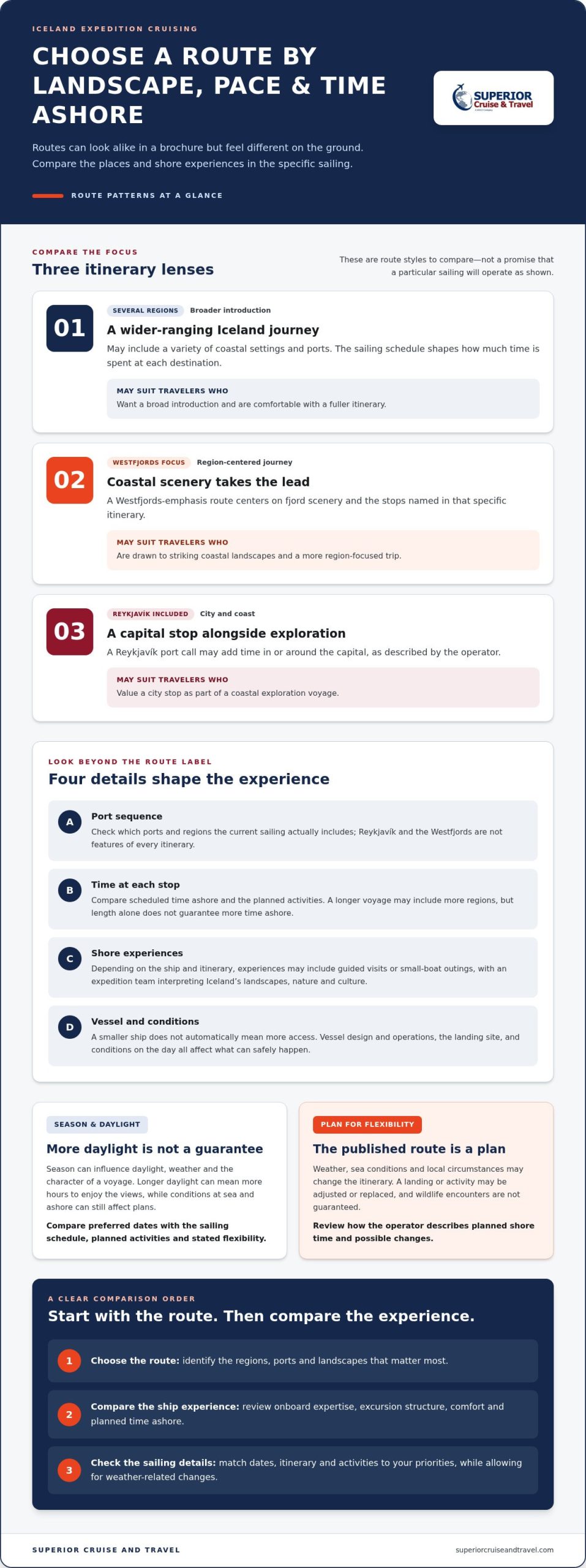
Choose a route based on the landscapes and pace you want, then check the sailing’s current itinerary to see which ports and shore experiences it includes. Some voyages concentrate on a stretch of coastline; others may cover several regions, with more time spent moving between destinations. Reykjavík, the Westfjords, and other areas aren’t features of every sailing, so compare the details for the specific itinerary you’re considering.
How do Iceland itineraries differ by region and length?
Regional focus shapes the feel of a voyage. A route emphasizing fjords may suit you if you’re drawn to dramatic coastal scenery, while a broader itinerary can offer a wider-ranging introduction to Iceland. Longer voyages may have more opportunity to include different regions or shore experiences, but length alone doesn’t guarantee more time ashore. Compare the actual port sequence, scheduled time at each stop, and planned activities.
Use this table to compare itinerary styles, not as a promise that a particular route will operate. The U.S. Department of State’s Iceland Country Information provides additional context on the country’s geography and climate as you consider what kind of journey appeals to you.
| Route focus | Likely experience | Traveler fit |
|---|---|---|
| Several Iceland regions | A wider variety of coastal settings and ports, with time shaped by the sailing’s schedule | Travelers seeking a broad introduction and comfortable with a fuller itinerary |
| Westfjords emphasis | A journey centered on fjord scenery and the stops named in that specific itinerary | Those drawn to striking coastal landscapes and a more region-focused trip |
| Reykjavík included | A port call that may complement the voyage with time in or around the capital, as described by the operator | Travelers who value a city stop alongside coastal exploration |
When should you consider season and daylight?
Season can influence daylight, weather, and the overall character of a voyage. Longer daylight can mean more hours to enjoy the views, while conditions at sea and ashore can still affect plans at any time of year. Rather than choosing a month based on a broad promise, compare your preferred dates with the sailing’s schedule, planned activities, and stated flexibility.
To compare iceland expedition cruises effectively, list the regions, ports, and shore experiences that matter most, then check them against each current sailing. If you’d like help weighing route options alongside the rest of your vacation, explore expedition cruise planning.
How to Compare Expedition Ships, Shore Excursions, and Comfort
A ship’s luxury label tells you little about how a day of exploration will feel. Compare guest capacity, onboard spaces, expedition-team expertise, and how excursions are organized. A smaller group may make it easier to hear a guide and move at a measured pace, while the vessel’s facilities and atmosphere matter during time at sea. No single ship feature guarantees a particular landing or level of comfort.
For iceland expedition cruises, make the comparison practical: what will you do ashore, how active is each outing, and what will the ship feel like between excursions?
What ship features matter on an Iceland expedition cruise?
Look beyond the ship’s category. Compare cabin layouts and comfort, public spaces, dining, and accessibility, then consider how much time the itinerary expects you to spend onboard. A smaller vessel may offer a more intimate atmosphere, while a larger ship may provide a broader range of facilities. The right balance depends on your priorities, not the label.
- Capacity and atmosphere: Consider whether you prefer a quieter, close-knit setting or more varied onboard spaces.
- Expedition expertise: Review how the team shares information about destinations and supports shore activities.
- Excursion structure: Check how outings are described, including group arrangements and activity levels.
- Comfort and access: Compare cabin and public-area details with your mobility needs and the time you’ll spend onboard.
How demanding are expedition shore excursions?
Depending on the operator’s plans, shore outings may involve walking, uneven ground, changing weather, or getting into and out of small boats. Read excursion descriptions carefully for details about walking distance, terrain, pace, and accessibility. Match those demands to your mobility and comfort preferences rather than assuming every outing will suit every traveler.
Sea conditions can affect how comfortable you feel onboard, and sensitivity to motion varies from person to person. If this is a concern, compare cabin locations and the ship’s layout with your preferences; no cabin choice can guarantee a motion-free voyage. Excursions and landing opportunities may also change with operational or environmental conditions, so treat published plans as a guide, not a certainty. A useful comparison weighs the experience you want against the flexibility expedition travel requires.
What to Check Before Booking an Iceland Expedition Cruise
A careful comparison can help you choose a voyage that fits your priorities and comfort level. For iceland expedition cruises, look beyond the headline route: itinerary details, excursion descriptions, and booking terms can show how much flexibility to expect and which parts of the trip you’ll need to coordinate.
Which itinerary and booking details should you compare?
Use this checklist to compare sailings consistently. Focus first on the details that shape your trip and expectations, then weigh personal preferences to decide which option feels right.
- Dates and departure: Compare sailing dates and departure arrangements with your wider travel schedule.
- Route and time ashore: Review the ports, planned stops, and scheduled time at each destination. Check that the itinerary includes the regions you want to experience.
- Ship: Compare the actual vessel’s cabins, public spaces, dining, accessibility, and onboard atmosphere rather than relying on a luxury label.
- Excursions: Read descriptions for activity level, walking demands, terrain, and how outings are organized. Distinguish planned experiences from those that may change.
- Inclusions: Check what the fare includes and which activities or other trip components are separate, so you can compare the overall experience fairly.
- Change and cancellation terms: Read the booking conditions, including how itinerary changes are handled and what cancellation terms apply.
Quotable rule: Check the route, dates, ship, excursions, inclusions, and booking terms first; then weigh preferences such as onboard atmosphere, pace, and activities.
How should you plan flights and travel protection?
Think of the cruise as one part of a larger vacation. Consider arrival timing, connecting travel, and whether you want time before or after the sailing instead of planning each component in isolation. Coordinating the schedule can make the trip easier to manage if arrangements need to shift.
Expedition itineraries can change with operational or environmental conditions, so read the operator’s terms and understand how changes may affect your plans. Travel protection is also worth considering for a multi-component trip. Review the relevant terms to understand what applies to your arrangements, without assuming any particular coverage or outcome. For guidance on coordinating cruise details, flights, and related plans, read the luxury cruise vacation planning guide.
Ready to compare your options? Plan your Iceland cruise vacation with support coordinating the cruise and its related travel components.
Plan an Iceland Expedition Cruise with Confidence
A clear decision order keeps the search manageable: start with the route and shore access, compare the ship experience next, then work through travel logistics. This helps you choose for the journey you want instead of getting distracted by a ship’s label or a long list of features. With iceland expedition cruises, flexibility is part of the planning, so leave room for itinerary changes as you arrange the rest of your vacation.
How can a travel advisor simplify expedition cruise planning?
Comparing expedition voyages means bringing together the itinerary, ship, excursion descriptions, and travel arrangements connected to the sailing. A full-service travel agency can organize those considerations and coordinate the cruise with related vacation components, making a complex plan easier to manage.
Superior Cruise and Travel draws on a global supplier network to support cruise and leisure vacation planning. This helps bring cruise options into context alongside the wider trip. For more perspective on the value of guidance and coordination, read why professional travel planning can be valuable.
What is the next step toward choosing your voyage?
Begin with a short list of priorities. Note your preferred travel dates, the landscapes or regions you hope to experience, the activity level that feels right, and the onboard comforts that matter most. Then consider the connected parts of the trip, such as arrival timing and other travel arrangements. Clear priorities make it easier to compare options and see where a compromise might be worthwhile.
From there, the planning process can bring those preferences together into a coherent cruise vacation. You don’t need every detail settled before you begin. A few well-chosen priorities can guide the comparison, while a flexible mindset helps account for changes to shore plans or conditions.
When you’re ready, plan an Iceland expedition cruise with a travel advisor who can help coordinate the voyage and its related travel components.
Choose Your Iceland Voyage with Confidence
The best iceland expedition cruises fit your priorities ashore as well as your expectations onboard. Start with route and access, compare the ship and excursions next, then review the practical details of your wider trip. Since conditions can affect plans, choose an itinerary you’ll enjoy even if some activities change.
Planning support can make those moving parts feel more manageable. Superior Cruise and Travel is a BBB-accredited full-service travel agency, with luxury cruise planning supported by a global supplier network. For multi-component travel experiences, travel protection options can also be included in your planning considerations.
Ready to turn your preferred landscapes, travel dates, and comfort priorities into a coordinated vacation plan? Plan your Iceland expedition cruise with Superior Cruise and Travel.
Frequently Asked Questions
What is an Iceland expedition cruise?
An Iceland expedition cruise prioritizes guided exploration and destination learning, rather than focusing mainly on a sequence of scheduled port visits. Depending on the ship and itinerary, the experience may include guided shore outings and interpretation from an expedition team about nature, culture, and landscapes. Ship capabilities and local conditions shape what’s possible, so planned landings and activities can change. Compare the actual shore experiences described for each sailing.
When is the best time to take an Iceland expedition cruise?
The best time depends on the daylight, weather, and travel experience you prefer. Season can affect how much daylight you have and the character of a voyage, but conditions vary, and no particular month guarantees specific weather or activities. Start with sailing dates that suit your schedule, then compare the itinerary and planned excursions for those dates. Leave room for adjustments, since conditions can influence shore plans.
Are Iceland expedition cruises suitable for first-time cruisers?
Yes, they can suit first-time cruisers who are comfortable with an itinerary that may be more flexible than a conventional port-by-port cruise. Before choosing, review the ship’s onboard spaces, the time at sea, and the excursion descriptions. If you’re unsure about motion or activity levels, consider those alongside your comfort preferences. Understanding how shore plans may change can help set realistic expectations before your first voyage.
Can Iceland expedition cruise itineraries change because of weather?
Yes. Weather and sea conditions can affect whether a ship can follow a planned route or offer a particular landing or excursion. The operator may adjust activities or the itinerary based on conditions and operational considerations. Review the booking terms and how the sailing describes possible changes, then plan connected travel with some flexibility. Treat scheduled landings and activities as planned opportunities, not guaranteed experiences.
What should I compare when choosing an Iceland expedition cruise?
Compare the route and ports first, including scheduled time ashore, then look at the ship, excursion structure, onboard expertise, and stated inclusions. Read activity descriptions for details such as walking demands, terrain, and pace, and review booking terms for itinerary changes and cancellations. For iceland expedition cruises, a useful choice matches your priorities on land and comfort needs onboard, not simply the ship’s luxury label.
How physically demanding are Iceland expedition cruise excursions?
Activity levels vary by sailing and excursion. An outing may involve walking, uneven terrain, changing weather, or boarding a small boat, while another may be less active. Read each excursion description and accessibility information carefully, then match the stated demands to your mobility and comfort preferences. If the itinerary offers several kinds of activities, compare their descriptions rather than assuming every landing follows the same pace or requires the same effort.
Do Iceland expedition cruises include flights and hotels?
Flights and hotels aren’t automatically included with every cruise. What’s covered depends on the specific sailing and travel arrangements, so review the inclusions for airfare, pre- or post-cruise accommodation, transfers, and other connected components. If these are separate, consider how their timing fits the ship’s departure. Coordinating the cruise with flights and lodging as one multi-component vacation can help make the overall schedule easier to manage.