
The best luxury family vacation isn’t built around keeping everyone together every minute. Learning how to plan a luxury family vacation starts with matching the destination, pace, and stay to your family’s ages, abilities, and interests, then balancing shared activities with time to recharge. A luxury cruise or all-inclusive resort can make that balance easier by bringing options for different generations into one trip.
It’s natural to want a vacation that feels special without turning every decision into another task. This guide will help you choose a travel expert, destination, and accommodations, then weigh whether a cruise or resort fits your family best. You’ll also find practical ways to plan activities around individual needs, make space for downtime, and create a trip that feels comfortable for everyone.
Key Takeaways
- Use a luxury travel expert to bring your family’s priorities, destination options, and trip logistics into one coordinated plan.
- Choose activities around each traveler’s interests and abilities, and leave room for breaks and unplanned moments.
- Match the destination and travel season to your family’s preferred pace, comfort needs, and appetite for adventure.
- Compare private suites and villas with shared spaces to find the right balance of together time and personal breathing room.
- Consider a cruise or all-inclusive resort when having varied activities and meals in one trip could simplify planning for multiple generations.
1. Benefits of working with a luxury travel expert
A travel expert can help families plan a luxury family vacation by coordinating travel, stays, and experiences. Share who’s traveling, what each person enjoys, and what the group hopes to spend. An expert can use those priorities to compare suitable options and organize the details around them.
Multigenerational travel takes more coordination because one itinerary must work for different preferences and schedules. A AAA travel agent advised beginning large multigenerational trips 12 to 18 months before departure. That lead time gives relatives room to discuss dates and budgets, while the organizer can compare options before committing. Families considering how to plan a luxury family vacation can also discuss gifting early. Relatives might agree on a shared contribution or a specific experience, then clarify the amount and purpose.
Set a total vacation budget before choosing a destination. Include transportation, accommodations, meals, excursions, and a reserve for incidental spending, then decide which categories matter most. For example, a family prioritizing a special stay may choose fewer paid excursions. A travel expert can help shape the itinerary around those priorities and the group’s overall vision.
Align the trip with your broader financial plan by deciding which funds are available and when payments fit your household schedule. Separate essential commitments from optional upgrades, and record shared contributions so each family member understands the arrangement. If work is part of the travel, keep its purpose, dates, and expenses distinct from family leisure in your records.
For U.S. tax purposes, business travel expenses must be ordinary and necessary to be deductible. A vacation does not become business travel simply because work appears on the itinerary; document the business purpose and related expenses separately. Multigenerational travel was described as one of the top three travel trends in 2019, reflecting interest in shared trips. Destination choices should still follow your family’s interests, timing, and budget.
For cancellation protection, compare what a plan covers, including cancellation, interruption, medical care, exclusions, and evacuation. The best fit depends on the nonrefundable parts of your itinerary and the risks you want covered. The Centers for Disease Control and Prevention recommends travel health insurance that includes medical evacuation coverage, so consider that alongside cancellation terms.
Before booking international travel, make a checklist for each traveler: passport validity, visa or entry rules, destination health requirements, and any needed medical records. Requirements can depend on the destination and traveler’s circumstances, so review applicable government guidance before departure. Keep documents accessible during transit, and share copies of essential details with the trip organizer.
There is no single daily budget that suits every luxury family trip. To calculate yours, divide the planned trip total by the number of travel days, using the same categories for each option. Accommodation style, destination, transportation, meals, excursions, season, and group size all affect the result. Compare like with like, then adjust the itinerary if the total no longer fits your financial plan.
2. Choosing destinations with activities for different ages
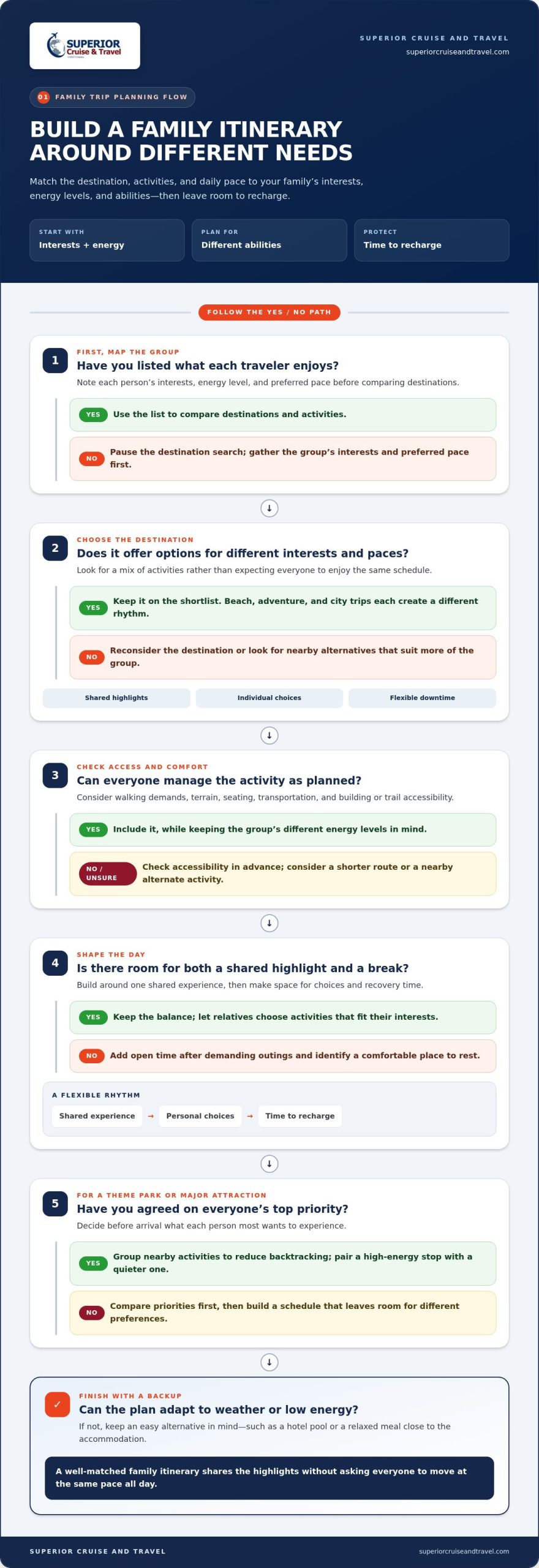
Start with a simple family inventory: list each traveler’s interests, energy level, and preferred pace. A child may want active outings, while a grandparent may favor cultural visits with comfortable seating and shorter walks. Look for destinations that offer both, rather than expecting everyone to enjoy the same schedule. A successful itinerary balances planned activities with free time, letting the family share highlights without spending every hour on the move.
Build each day around one shared experience, then give family members meaningful choices. At a beach destination, for example, some relatives might enjoy water sports while others relax nearby or explore local culture. A family-friendly property may offer kids’ clubs, babysitting services, and family pools, giving adults time for spa facilities or fine dining. Treat these as ways to complement family time, not reasons to overfill the itinerary.
For a theme park or major attraction, agree on priorities before arrival. Ask each person to name the experience they most want, then group nearby activities to reduce unnecessary backtracking. Pair a high-energy attraction with a quieter stop, such as a garden, indoor exhibit, or relaxed meal. This approach can keep children engaged and give adults a chance to enjoy more of the destination.
Plan for differences in ability, not just age. A younger traveler may manage a long outing, while an older relative may prefer a shorter route; neither preference should define the whole group’s plans. Check the walking demands, terrain, seating, and transportation for each activity. If a family member has physical limitations, ask about building and trail accessibility in advance. Choose an alternate activity nearby so the group can adjust without abandoning the day.
Schedule breaks as deliberately as excursions. Leave open time after a demanding outing, and identify a comfortable place where tired travelers can rest while others continue. For instance, a cultural tour can be followed by a flexible afternoon rather than another timed event. Keep a backup plan for weather or low energy, such as a hotel pool or an easy meal close to the accommodation. If a cruise is among your options, compare family cruise itineraries for activities that suit different interests.
3. Choosing destinations suited to family needs
Choose a destination by matching your family’s preferred pace with its shared interests. Beach, adventure, and city trips each create a different rhythm, so compare travel time, planned activities, and downtime before deciding. A beach stay may suit relatives who want unhurried days, while an adventure itinerary may appeal to travelers eager to explore. A city break can bring cultural experiences closer together, but usually involves more daily movement.
Use trip length and season to narrow the choices. For example, a private yacht charter in Greece’s Cyclades Islands is recommended for 7 nights, with May through October identified as the recommended season. Families can add 2 nights in Athens to include city time. This pairing lets you consider a distinct destination experience without making every day follow the same pattern.
For families drawn to wildlife and exploration, a private yacht charter in the Galápagos Islands is recommended for 7 nights and suits travel year-round. A land-based family trip to Belize is recommended for 6 nights, with November through April identified as the recommended season. These examples offer different ways to structure an adventure-focused vacation, and specialists like Adventure1 design bespoke adventure itineraries tailored to group abilities and preferences. Choose the format that best fits your family’s comfort preferences, pace, and interest in time on land or water.
Croatia’s Dalmatian Coast offers another yacht-based itinerary to consider: the recommended trip lasts 7 nights, and it can be extended with 2 nights in Dubrovnik. If a shorter estate stay appeals to your group, a private estate on Panama’s Azuero Peninsula is recommended for 4 nights, with a possible 2-night extension in Panama City. That combination brings a city stay into the plan while keeping the estate as the main destination.
Compare vacation packages by looking beyond the destination name. Check how the itinerary distributes travel days, activities, meals, and open time, then decide which elements matter most to your family. A package should make the overall plan easier to understand, not simply add more scheduled experiences. Ask each traveler to choose a priority, such as a cultural visit, an outdoor excursion, or a quiet day, and use those preferences to shape the itinerary.
Family-friendly luxury destinations may offer kids’ clubs, babysitting services, and family pools. These features can help families balance shared time with individual interests, especially when children and adults want different activities. Consider how each option fits your group’s needs and preferred pace. The right destination supports memorable experiences while giving every traveler room to enjoy the trip in their own way.
Family preferences and shared accommodations
Before choosing a suite or villa, ask each household what makes a getaway comfortable. Parents may value quiet evenings, while children may want room to play and grandparents may prefer fewer stairs. Write down shared priorities, then separate essentials from nice-to-haves. For example, if everyone wants relaxed mornings, choose a layout with a living area where early risers can gather without waking other guests.
Shared accommodation doesn’t have to mean sharing one bedroom. Private suites and villas with multiple bedrooms and living spaces let relatives spend time together while keeping some personal space. The Esola family’s Taiwan trip in spring 2017 offers one practical model: they booked three hotel rooms, one for each couple. Separate rooms can suit adult siblings or couples who value privacy, while a shared lounge preserves opportunities for family moments.
Compare room layouts, not just the property’s name or overall size. Check how bedrooms connect to bathrooms, where children can sleep, and whether common areas give the group space to eat or unwind together. A villa with several bedrooms may suit relatives who want shared meals and downtime. Separate suites may work better when household routines differ, such as early bedtimes or quiet work periods.
For a private estate stay on Panama’s Azuero Peninsula, the recommended itinerary is 4 nights, with an optional 2-night extension in Panama City. This gives families a concrete way to think about combining a quieter home base with a city stay. Consider how each move affects unpacking, rest, and time together. Fewer accommodation changes can make a multi-household trip feel simpler.
Private accommodations can also shape how your family experiences a destination. Pair a villa or estate stay with a guided tour that reflects the group’s interests, such as local culture or nature. Before choosing, compare the tour’s pace, meeting point, and time away from the accommodation. A private guide may make it easier to adapt the outing to your group’s preferences than a fixed schedule.
Agree on shared-space expectations before departure. Decide which meals the family wants to enjoy together, when relatives can make separate plans, and how everyone will communicate changes. For instance, a family staying in a villa can plan one shared dinner while leaving other evenings open. That simple agreement helps preserve the ease of a luxury getaway while giving each household room to create its own moments.
5. Cruises and all-inclusive resorts for families
A cruise can simplify a multigenerational trip by combining accommodations, meals, and changing destinations in one journey. The Meyer family’s Alaska cruise lasted a week and included 33 family members. That example shows how a ship can bring a large group together while offering a shared itinerary. Compare the route, onboard activities, shore excursions, and cabin arrangements before deciding whether a cruise suits your family.
Look closely at what each cruise day involves. A day at sea offers time to use onboard facilities, while a port day may mean an early start and a planned excursion. Choose an itinerary with a mix that suits your group’s pace. Review cabin locations and layouts, too, since proximity can make it easier for relatives to meet while maintaining their own space.
An all-inclusive resort can simplify planning by bringing meals and activities together in one package. Family-friendly properties may offer on-site cooking classes, water sports, and guided nature walks. Compare those choices with your family’s interests, then consider whether the activities suit children and adults alike. A resort can work well for families who prefer a comfortable home base over moving between ports or destinations.
How do luxury all-inclusive resorts compare with villas and hotels for families? Resorts can simplify daily planning with meals and activities in one place, while villas offer private living space and hotels may provide separate rooms. Choose based on whether your family values included experiences, privacy, or a mix of room types.
For a more exclusive escape, compare the overall details rather than focusing only on headline inclusions. Check which meals and activities are covered, how the schedule works, and what options exist for different ages. At a resort, ask whether the listed activities run throughout your stay; on a cruise, compare port experiences with onboard choices. Those distinctions clarify the experience each itinerary offers.
Health preparation is part of cruise planning. According to the Centers for Disease Control and Prevention (CDC), people planning cruise ship travel should be up to date with their COVID-19 vaccinations because cruising poses some risk of SARS-CoV-2 transmission. Include this consideration as you prepare for the trip.
Make a family comparison before choosing: list the preferred pace, shared activities, accommodation needs, and how much structure feels comfortable. If your family favors an itinerary with ports and onboard choices, explore luxury cruise options. If staying in one destination appeals more, compare resort vacations against the group’s priorities. The best fit is the escape whose day-to-day details support the kind of time together your family wants.
Superior Cruise and Travel: Luxury Cruises
Superior Cruise and Travel helps families compare luxury cruises and resort vacations based on their preferred pace, activities, and accommodation needs. If a cruise appeals to your group, consider whether a traditional itinerary, a chartered cruise ship, or a world cruise better fits your shared vision. For a land-based stay, a resort vacation may suit families who prefer to settle into one destination and enjoy activities from a single home base.
Bring your family’s priorities together before choosing: destinations everyone hopes to see, the balance of shared and independent time, and the kind of experience that feels right. These details help narrow your options and guide the planning conversation. To explore a family cruise or resort vacation, contact Superior Cruise and Travel.
Make Your Family’s Next Journey a Shared Vision
Choose one decision-maker to gather each household’s priorities, then bring those preferences into a planning conversation. This gives your family a clear starting point and helps turn ideas into a journey everyone can look forward to. A thoughtful next step in planning a luxury family vacation is deciding what kind of time together matters most, from relaxed days at sea to a longer voyage with more destinations.
Superior Cruise and Travel offers luxury cruises, chartered cruise ships, and world cruises, giving families different ways to shape a sea-based escape. As you compare possibilities, focus on the experience your family wants to share rather than trying to fit every preference into one itinerary. The right direction can make planning feel more intentional and give everyone something to anticipate.
Contact Superior Cruise and Travel to explore options for your family’s next journey. Start the conversation with your shared vision, and take the next step toward making it a trip to remember.
Frequently Asked Questions
What is the best time of year to book a luxury family vacation?
The best time to travel depends on your destination’s season and your family’s schedule. For example, the recommended season for Belize is November through April, while Greece’s Cyclades Islands are recommended from May through October. Choose travel dates around the experiences you want, then compare them with school breaks and relatives’ availability. For a destination suitable year-round, a private yacht charter in the Galápagos Islands is one option.
Which luxury destinations and resorts are best for families with children?
The best choice is a destination with experiences children enjoy and practical comforts for accompanying adults. Look for family-friendly properties with kids’ clubs, babysitting services, and family pools, then consider how those features fit your child’s routines. A resort offering activities such as cooking classes or guided nature walks can give families shared experiences beyond the pool. Compare the setting and pace with your children’s interests before choosing.
How far in advance should you book luxury family travel?
For a large multigenerational trip, begin planning at least 12 to 18 months before departure. That gives relatives time to coordinate calendars and discuss preferences before the organizer narrows down destinations and travel dates. Once the group agrees on a direction, make decisions in sequence: settle dates, choose the trip style, then arrange travel and accommodations. This approach helps keep the plan manageable for a group with different schedules.
What should a luxury family vacation budget include, including flights, lodging, meals, and activities?
Build the budget from separate categories: flights or other transportation, lodging, meals, activities, local transfers, and travel protection. Add a line for incidental spending, such as snacks or souvenirs, so it doesn’t get mixed into planned excursions. Then compare options using the same categories; an all-inclusive package and a hotel stay may cover different items. Divide the planned total by trip days to estimate your family’s daily budget.
Which family-friendly luxury resorts offer kids’ clubs, babysitting, and childcare?
Look for family-friendly resorts that describe kids’ clubs, babysitting services, and family pools among their amenities. Rather than choosing by a feature name alone, consider whether the activities suit your children’s interests and fit your family’s schedule. A resort with guided nature walks or cooking classes may offer appealing shared alternatives. Compare the available activities and setting with the kind of trip your family wants.
How can you choose age-appropriate activities and balance relaxation with sightseeing?
Choose activities by matching each outing’s pace and physical demands to the people joining it. For example, pair a walking tour with a seated cultural activity, then leave the rest of the day flexible. Ask each traveler to name one priority before building the schedule, and avoid stacking every day with timed events. This gives the group meaningful shared plans while leaving room to rest or change course.
How can families plan for accessibility, dietary needs, and safety at their destination?
Plan for these needs before finalizing the itinerary: note mobility requirements, dietary restrictions, and health considerations for each traveler. For accessibility, ask about routes through buildings and trails, and consider how transfers affect the day. Share dietary needs with the accommodation and restaurants in advance. Review current destination entry and health guidance. The Centers for Disease Control and Prevention recommends travel health insurance that includes medical evacuation coverage.
How much does a luxury family vacation cost per day?
There’s no single daily cost for a luxury family vacation. Divide your planned trip total by the number of travel days, including transportation, accommodations, meals, excursions, and incidental spending. Costs vary with destination, season, group size, and travel style.