
The best Greek yacht itinerary isn’t simply the one that covers the most islands. It’s the one that fits the season, your group, and the conditions at sea. A luxury yacht charter in Greece generally runs from April through October, and summer routes in the Aegean should account for potentially strong Meltemi winds.
It’s easy to see why choosing when to go is only the beginning: the right yacht, crew and cruising region all shape the pace and feel of your time on board. This guide will help you weigh the seasons, match yacht and crew options to your group, and plan a route through Greece’s distinct cruising regions. You’ll also find practical guidance on how listings can help you narrow the possibilities, so your next planning decisions feel clear and considered.
Key Takeaways
- Choose a cruising region around the experience you want, from island-hopping to time ashore for beaches and cultural attractions.
- Match the yacht’s layout and crew to your group’s size, preferred pace, and onboard priorities.
- Weigh seasonal weather and Aegean wind conditions when shaping the timing and direction of your route.
- Plan an itinerary around realistic travel distances and the stops that matter most to your group.
- Use yacht listings to compare the details that affect fit, then narrow your options for the upcoming trip.
What Is The Best Time Of Year To Charter A Yacht In Greece?
The Greek yacht charter season runs from April through October, with May and September offering a comfortable balance for exploring. During those shoulder-season months, temperatures typically range from 72°F to 84°F (22°C to 29°C). Summer brings warmer days, but strong Meltemi winds can affect routes across the Aegean. For a luxury yacht charter in Greece, the best timing depends on whether you prioritize warm-weather swimming, quieter island stops, or flexible passage planning.
Greece’s island groups offer distinct settings for a route. The Cyclades comprise 220 islands and are described as the country’s most popular yachting destination. Mykonos and Santorini suit travelers drawn to lively ports and dramatic scenery, while Paros offers beaches and sheltered bays. The Dodecanese includes twelve islands, with Rhodes and Kos providing options for combining coastal time with historic sites. In the Sporades, Skiathos and Skopelos bring a different island-hopping rhythm, with green landscapes and inviting beaches.
Choose a region based on the kind of days your group wants. The Saronic Gulf makes Athens a practical starting point for shorter passages and visits to islands such as Hydra and Poros. In the Ionian Islands, Corfu and Kefalonia pair harbor visits with beaches and scenic anchorages. The Cyclades suit a route around iconic islands, though summer Meltemi winds can influence which crossings work best. A focused route leaves more time for swimming, meals ashore, and unhurried stops.
Greek history and architecture add depth to time ashore. In Athens, the Acropolis and its ancient monuments offer a landmark cultural visit before or after cruising. On Delos, archaeological remains connect a Cyclades stop with the ancient Greek world. Rhodes Old Town brings medieval streets and fortified architecture to a Dodecanese itinerary, while Santorini’s whitewashed villages contrast with volcanic scenery. These stops help balance beach days with cultural exploration.
Activities vary by destination: swim from a secluded cove near Paros, explore Hydra’s harbor on foot, or visit archaeological sites on Delos. Independent bareboat skippering requires a sailing certificate in most destinations. A charter professional can determine which credential applies to your Greek charter and vessel, and explain how choosing a crewed yacht changes the requirements for your party.
A professional can match your travel dates and group needs with a suitable yacht, then shape the route around your chosen region and season. Plan as early as practical for your trip, since timing, yacht choice, and popular destinations affect which options remain available. A May itinerary through the Saronic Gulf and a summer Cyclades route involve different considerations, especially when wind conditions may affect passage choices.
Start with your preferred travel period, guest count, and must-have experiences. Then narrow your choice of island groups, such as the Cyclades for well-known destinations or the Ionian Islands for a different coastal setting. With those priorities in place, a professional can develop a route that balances beaches, cultural attractions, and time at sea.
Yacht types, crew, and guest capacity
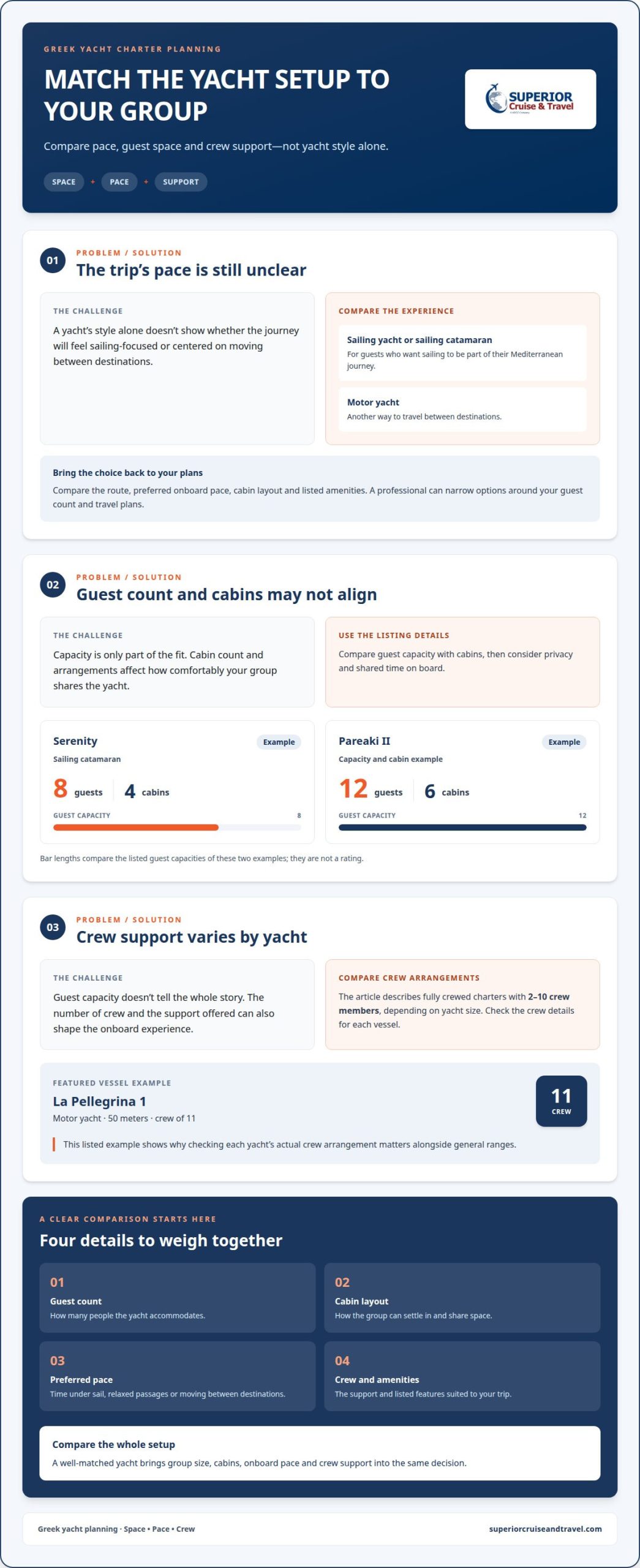
For a Greek itinerary, compare sailing yachts, sailing catamarans, and motor yachts by space, pace, and suitability for your group. A yacht’s cabins and crew arrangement can shape the experience as much as its style.
Yacht Type Options
Sailing yachts and catamarans suit guests who want sailing to be part of their Mediterranean journey, while motor yachts offer another way to travel between destinations. A sailing catamaran such as Sameli measures 23 meters, giving a concrete example of the range available. The right comparison considers your route, preferred onboard pace, cabin layout, and the amenities listed for each yacht.
Crew and Guest Capacity
Guest capacity and cabin count help determine whether a yacht fits your group comfortably. Pareaki II accommodates up to 12 guests in 6 cabins, while Serenity accommodates up to 8 guests in 4 cabins. A fully crewed charter can have two to ten crew members, depending on yacht size. The professional’s comparison should account for both guest arrangements and the level of crew support suited to your trip.
Featured Fleet Choices
Specific vessels make fleet comparisons more useful than broad yacht categories alone. Serenity is a sailing catamaran with capacity for 8 guests in 4 cabins; La Pellegrina 1 is a 50-meter motor yacht with a crew of 11. These examples show how substantially capacity and onboard staffing can differ. Consider which layout supports your group’s privacy, shared time, and planned summer days.
For a special trip through the Cyclades, the decision isn’t simply sailing yacht versus motor yacht. Choose a configuration that suits your group’s preferred rhythm: time under sail, relaxed passages, or a route focused on moving between destinations. A professional can narrow the options using your guest count, cabin needs, and travel plans, rather than relying on yacht length alone.
Look beyond capacity when comparing a vessel’s listed amenities. Cabin arrangements, shared areas, and the features described for each yacht affect how well it suits families, couples, or friends. These details matter during a longer stay, when guests need comfortable shared spaces and a practical way to settle into life on board.
For an upcoming Greek itinerary, private yacht planning can bring guest capacity, yacht type, and route preferences into one decision. Share your group’s priorities and preferred destinations so the next comparison focuses on vessels that match the experience you want.
Best time of year and seasonal weather
Greece’s charter season spans April through October, but the best dates depend on your priorities for swimming, sailing, and route. Late May through early October is considered an ideal charter window.
Charter Seasons
May and September suit travelers seeking warm days without the height of summer. Temperatures during these shoulder-season months typically range from 72°F to 84°F (22°C to 29°C). June through August brings peak summer heat, with temperatures reaching 95°F (35°C). Choose dates by weighing your preferred pace, comfort in warmer weather, and interest in quieter stops.
For swimming, summer offers warm waters, with sea temperatures peaking at 79°F (26°C) from June through August. Spring and autumn can suit guests prioritizing sailing and time ashore over long swims. April begins the charter season, while October marks its close. These seasonal boundaries help frame an upcoming vacation, but the route and local conditions still shape each day.
Weather and Sailing Winds
Summer Meltemi winds can be strong in the Aegean, so account for them when planning exposed passages. A Cyclades itinerary may need a flexible sequence of stops if wind conditions affect a crossing. A professional considers the forecast and vessel when planning daily sailing, then adapts the route to conditions. This helps balance island visits with prudent passage planning.
The main weather risk is strong summer Meltemi winds in the Aegean, which can affect crossings and change the planned route. The skipper manages safety by assessing sea conditions and adjusting passage plans. Cancellation terms are set out in the booking agreement.
Weather also shapes the style of a Greek sailing vacation. A summer itinerary may prioritize protected bays and shorter passages, while a May or September plan may put more emphasis on sailing between destinations. Conditions differ by region, so a route through the Ionian Islands does not face the same Aegean wind considerations as a Cyclades crossing.
Seasonal charter pricing varies by yacht type and travel dates. The cost also reflects the selected yacht, itinerary, and arrangements included in the charter. The price depends on the trip requested and is provided after a quote request. Yacht type, season, route, and onboard requirements shape the quote.
For your next trip, decide whether warm swimming waters or a sailing-focused itinerary matters more. Then match your travel dates to the intended region and leave room for weather-related route changes. These priorities give a charter professional practical criteria for shaping a suitable plan.
Itinerary planning and cruising regions
A Greek itinerary works best when its cruising region, available days, and arrival point fit together. Decide which experiences matter most, then shape the route around realistic passages and time ashore.
Athens and Saronic Gulf Routes
Athens is a natural starting point for exploring the Saronic Gulf, where an itinerary can combine time in the city with nearby island stops. Poros, Hydra, and Aegina offer contrasting places to spend time ashore. Keep the route focused if ancient history and harbor visits matter more than covering a wide stretch of the Aegean. A focused plan also leaves room for relaxed stops.
Cyclades Itinerary Highlights
A Cyclades route can connect well-known islands with distinct scenery and cultural stops. An eight-day example focuses on discovering the Cyclades, giving the itinerary a defined timeframe rather than an open-ended island-hopping plan. Mykonos and Santorini are recognizable highlights, while Delos offers an ancient archaeological visit. For a summer route, plan the passage order around Aegean winds and distances between islands.
Sample Charter Itineraries
Sample schedules help set expectations for how much a route can cover. A Cyclades example lasts eight days; “Discover the Wonders of the Cyclades and the Saronic Gulf” is listed as a 10-day itinerary. “Experience the Wonders of Greece and Turkey” spans 11 days, while a Northern Sporades trip is listed for six days. Compare the focus and duration before settling on a route.
Marinas and Airport Starting Points
For a Saronic Gulf itinerary, plan your arrival around Athens, then match the embarkation marina to the yacht’s departure base. This keeps your arrival point connected to the first sailing day. The most convenient marina and airport depend on the selected vessel and route, and an itinerary professional can coordinate these as part of the plan. Build in time for arrival and boarding.
For an Ionian itinerary, choose a starting point that supports your intended island sequence rather than combining distant regions in a short trip. An Aegean route can focus on the Cyclades, while a superyacht itinerary may allow a broader selection of destinations. In either case, the number of days and the time you want ashore determine how much ground the route should cover.
Use three decisions to refine your itinerary: select the region, set the trip duration, and prioritize cultural visits, swimming, or sailing. Then arrange destinations in a practical order, leaving flexibility for conditions at sea. This turns a broad Greek adventure into a coherent cruising plan without crowding every day with another island.
Greece charter yacht listings
Greek yacht listings range from sailing catamarans to large motor yachts, so compare vessel type, length, guest capacity, and cabin details first. These details help narrow a private charter to options suited to your group and route. A stunning listing photo may capture Greece’s natural beauty, but the vessel’s specifications tell you more about how it fits your trip.
Length offers one useful point of comparison. The Greek listings include Azul at 16.56 meters, Why Not at 23.1 meters, and Jaan at 42.06 meters. Larger examples include Shalawaty at 56.2 meters and O’Pari at 95 meters. These dimensions describe very different vessel scales, but length alone doesn’t establish guest capacity, cabin configuration, or the onboard experience.
Compare the details that affect how your group will use the yacht. A listing’s stated capacity and cabin arrangement help you assess sleeping plans, while the vessel type gives you a sense of the trip. For example, a sailing yacht may suit guests who want sailing to shape their days. A motor yacht may better match plans focused on cruising between destinations.
Listings also help distinguish a crewed charter from other arrangements. For a crewed option, consider the listed crew alongside the vessel’s size and guest capacity. La Pellegrina 1, for example, is 50.00 meters long and has a crew of 11. That specific detail helps set expectations about the vessel’s staffing, without implying that every yacht offers the same crew arrangement.
For a sense of scale at the upper end, IJE is listed at 108 meters. Compare it with Va Bene at 47.5 meters and Condor A at 42.4 meters. The ultimate choice isn’t simply the longest yacht: it’s the vessel whose size, configuration, and stated capacity align with your group and itinerary. Look at those particulars before focusing on the listing’s visual appeal.
Use a practical shortlist: match the vessel type to your preferred cruising style, compare capacity and cabins with your group, then review the stated length and crew information. A family seeking shared space may prioritize a different configuration from a couple planning a quiet escape. This process makes it easier to identify which listings deserve closer consideration.
Specifications make yacht listings more useful when read together, not as isolated selling points. Pair the vessel details with your preferred cruising region and trip plans, then focus on options that fit both. For help shaping the next step, explore private yacht options for your Greece itinerary.
Superior Cruise and Travel: Luxury Cruises
Superior Cruise and Travel can help turn your preferred Greek season, yacht style, and route into a considered travel plan. If a private yacht suits your group, its Private Yachts offering connects the vessel decision with your cruising priorities. Travelers considering a larger shared voyage can explore Chartered Cruise Ships and Luxury Cruises. World Cruises are another option for those planning beyond Greece.
Turn to Superior Cruise and Travel when you’re ready to move from comparing destinations and yacht details to planning your trip. Share your preferred travel period, group priorities, and the Greek regions you hope to explore. These choices provide a clear starting point for planning a journey that fits your plans.
Contact Superior Cruise and Travel to discuss your Greece cruise plans.
Shape Your Next Greek Escape
Your next step is to turn your preferred travel experience into a clear planning brief. Consider who is travelling, what you want each day to feel like, and which priorities matter most: time ashore, onboard privacy, or a particular cruising pace. These choices help focus the conversation on a personal journey rather than an overfilled itinerary.
A luxury yacht charter in Greece is a significant travel decision, so begin with the experience you want to create, not just a vessel listing. With your priorities in mind, Superior Cruise and Travel can help you explore the right direction for your plans. If you’re considering a broader voyage, Luxury Cruises, Chartered Cruise Ships, and World Cruises offer other ways to travel.
When you’re ready to take the next step, contact Superior Cruise and Travel to discuss your plans. A thoughtful starting point can make it easier to shape a Greek escape that feels distinctly yours.
Frequently Asked Questions
What Is Included In The Fee On A Greek Yacht Charter?
The charter agreement defines what the fee covers, so review its inclusions line by line. Check whether crew, meals, fuel, provisioning, and port charges are included or billed separately. Terms vary between vessels and arrangements. For example, a quoted charter rate may not cover every operating expense during the voyage. A clear breakdown lets you compare options on the same basis before choosing.
How much does a superyacht charter in Greece cost?
There isn’t one standard rate for a superyacht charter in Greece. The quote reflects the yacht, travel dates, itinerary, crew arrangements, and expenses associated with the trip. A longer route or different onboard requirements can change the overall amount. Ask for a breakdown separating the charter rate from additional expenses, so you understand what the planned voyage includes before deciding.
Is a yacht rental in Greece good for older people?
A yacht holiday can suit older travelers when the vessel’s layout and daily plan match their mobility and comfort needs. Consider boarding access, stairs between cabins and shared areas, bathroom arrangements, and how easily guests can move around on board. A route with shorter passages and convenient time ashore may also feel more manageable. Discuss these priorities when narrowing vessel and itinerary options for your group.
What does a luxury yacht charter in Greece cost per week?
The weekly quote is shaped by the selected yacht, season, route, crew, and expenses assigned to the charter. Listings may show different rates for different vessels, but a listed base rate may not represent the full trip total. Compare written quotes by checking the dates, inclusions, and excluded expenses. This gives you a clearer picture of the cost for your planned week.
What is included in a luxury yacht charter price in Greece, and what costs extra?
The booking terms specify which services and expenses the charter price covers. Review how meals, provisioning, fuel, mooring, taxes, and crew gratuity are handled, since they can affect the final trip budget. Don’t assume an item is included simply because it appears in an itinerary or yacht listing. A written cost breakdown helps distinguish agreed charter services from additional voyage expenses.
Which Greek islands and sailing regions are best for a luxury yacht charter?
The best region is the one that fits your group’s preferred pace and interests. Choose the Saronic Gulf for an itinerary connected with Athens, or consider the Cyclades for iconic island stops and cultural visits. The Ionian Islands offer another cruising area to consider when building your route. Focus on the experience you want, then select destinations that fit the time available.
When is the best time of year to charter a luxury yacht in Greece?
The best time depends on your priorities for swimming, sailing, and time ashore. Travelers focused on warm-water swims may prefer the height of summer, while those seeking a different balance may consider shoulder-season dates. The Aegean’s summer Meltemi winds can affect passage planning, so consider your region and route alongside the calendar. Choose dates around the experience you want, with flexibility for conditions at sea.
How do crewed, bareboat, and skippered yacht charters compare in Greece?
A crewed charter includes a crew to operate the yacht and support the voyage. With a bareboat arrangement, guests take responsibility for operating the vessel, subject to applicable qualifications and requirements. A skippered charter adds a skipper, while the rest of the onboard arrangements differ from a fully crewed experience. Compare who handles navigation, daily operations, and guest services before choosing the format that suits your group.