Monaco’s Grand Prix is a Formula 1 race run on the streets of Monte Carlo and La Condamine, not on a purpose-built circuit. For a cruise to Monte Carlo for the Formula 1 motor racing Grand Prix, the setting is part of the event: the Circuit de Monaco measures 3.337 kilometers and winds through the city.
It’s easy to see why the Monaco Grand Prix is known for its demanding street circuit. Tight corners and narrow roads make the course distinctive, and its most notable turns each bring a different challenge for drivers.
This guide explains the Monaco Grand Prix and highlights the turns that define its course, including the famous hairpin and Swimming Pool section. You’ll get a clear sense of what makes the race special before planning a cruise around the event.
Key Takeaways
- Understand how a Formula 1 race transforms Monaco’s city streets into a demanding circuit and what makes the event distinctive.
- Learn which famous turns shape the circuit, including the tight hairpin and the Swimming Pool section.
- See how Monaco’s compact setting influences a cruise visit compared with other Grand Prix destinations.
- Plan around event-day crowds and movement between the circuit, tender landing site, and ship.
- Allow for an approximately 30-minute walk between the tender landing site and grandstand, and build extra flexibility into your return plan.
What Is The Grand Prix Race in Monaco?
The Monaco Grand Prix brings Formula 1 racing onto the streets of Monte Carlo and La Condamine. A cruise to Monte Carlo for the Formula 1 motor racing Grand Prix combines a city visit with a race held on public roads. The Circuit de Monaco measures 3.337 kilometers, threading through the principality rather than sitting apart from it. For cruise visitors, that urban setting shapes both the viewing experience and the practical plan for time ashore.
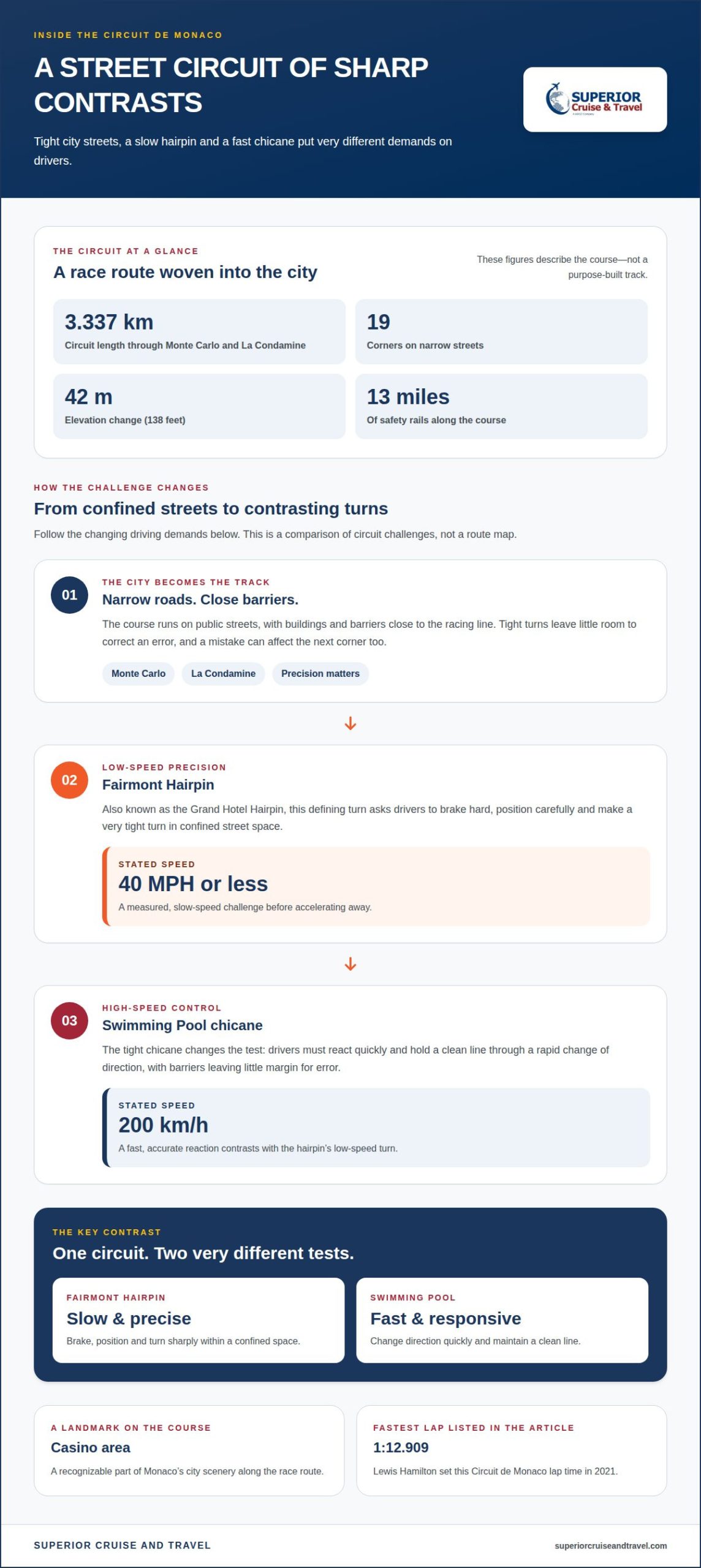
The circuit has 19 corners, with buildings and barriers close to the racing line. Drivers navigate tight turns and narrow streets where there’s little room to correct an error. The course includes the famous Fairmont Hairpin and Swimming Pool section, each demanding a different approach. The hairpin requires drivers to slow to 40 MPH or less, while the Swimming Pool chicane is taken at 200 kilometers per hour. Those contrasts help explain the circuit’s distinctive challenge.
For travelers planning a Monte Carlo cruise around the Formula 1 motor racing Grand Prix, the race schedule helps organize a visit. The 2027 event is scheduled for June 4-6, with qualifying on June 5 and race day on June 6. Qualifying determines the starting order, so it offers a separate opportunity to watch the drivers compete on the circuit. Race day is the main event, but the weekend’s sessions each provide a different way to experience the course.
Viewing options shape what you’ll see. Grandstand tickets provide a seat beside a particular part of the circuit, while a yacht-based experience offers a harbor setting. F1 Paddock Club tickets provide access to Formula 1 sessions, but don’t include Formula 2 or Formula 3 races or grandstand access. A future cruise to Monte Carlo during the Formula 1 motor racing Grand Prix can therefore be planned around your preferred setting and sessions. Check the ticket description against your viewing priorities before settling on an itinerary.
The race’s history adds context to its reputation. The Monaco Grand Prix first ran in 1929 and has been part of the Formula 1 World Championship since 1950. Ayrton Senna won six times, while Michael Schumacher and Graham Hill each won five times. The difficulty is also reflected in finishing records: only four cars finished in both 1966 and 1996. These milestones show how the tight streets have tested drivers across generations.
The Circuit de Monaco has an elevation change of 138 feet (42 meters), and the Monaco Grand Prix circuit has 13 miles of safety rails. The course also includes a swimming-pool chicane, adding another distinctive feature to the route.
The Monaco Grand Prix is a race on a demanding street circuit. Lewis Hamilton set the listed fastest lap time at the Circuit de Monaco in 2021, with a time of 1:12.909. These figures reflect the demands of an event where drivers repeatedly negotiate a circuit with a notable elevation change and extensive safety rails.
Notable turns on the circuit
At the Monaco Grand Prix, the circuit’s most famous turns are part of the city itself. Drivers thread through narrow streets, with buildings and barriers close to the racing line. The layout rewards precision: a small mistake can compromise the next corner, not just the one a driver is negotiating. The French Riviera setting makes a striking backdrop, but the streets remain a demanding Formula One course. For trackside guests, each location offers a different perspective on how drivers handle Monaco’s changing rhythm.
The legendary Fairmont Hairpin, also known as the Grand Hotel Hairpin, is a defining example. Drivers must slow to 40 MPH or less to negotiate its tight curve. The turn’s slow speed contrasts sharply with faster parts of the circuit, making braking and precise positioning essential. It also gives spectators a clear illustration of the challenge: cars must turn sharply within a confined street space, then accelerate away. The Casino area offers another recognizable landmark, linking the race route with Monaco’s famous city scenery.
At the Swimming Pool section, drivers take a tight chicane at 200 kilometers per hour. This rapid change of direction presents a very different test from the hairpin’s low-speed turn. The sequence demands quick control and a clean line through the chicane, while barriers leave little margin for error. Watching both sections helps guests witness the circuit’s variety: the hairpin calls for measured speed, while the Swimming Pool demands fast, accurate reactions. Together, they explain why Monaco’s urban course feels so distinctive.
Circuit-side yacht viewing offers a separate way to experience the weekend. Port Hercule places boats within Monaco’s harbor setting, while the track runs through nearby city streets. Explora I is scheduled to dock 150 metres from the F1 Paddock Club during the upcoming event. That proximity is specific to the ship and location; it doesn’t mean every vessel sits beside the same circuit section. A yacht-based experience can suit guests who want the Mediterranean setting alongside the race, while a grandstand centers the view on a chosen trackside location.
Choose by the view you want to remember: close-up corner action, a harbor perspective, or both across the weekend. A Grand Voyage can make Monaco one part of a broader Mediterranean itinerary, while a private yacht offers another onboard setting for experiencing the principality. For a future voyage that includes Monaco, explore Mediterranean cruise planning as you shape the trip around your preferred race-day perspective.
How does the Monaco Grand Prix compare with other Formula 1 races for cruise visitors?
Monaco combines Formula 1 with a compact city and a Mediterranean harbor. That changes the visitor experience compared with races where the circuit sits apart from the host city. In Monte Carlo, the Grand Prix route is part of the streetscape, while Port Hercule places cruise travel within the same destination. The comparison is not simply about choosing a famous race. It’s about how the circuit, port, and surrounding city fit together during your visit.
For cruise visitors, the key is how the ship’s itinerary connects with the event. In Monaco, a port call can combine time in the principality with the race. At a Grand Prix farther from its port or city center, getting between the ship, circuit, and other sights may shape more of the day. Consider whether you want a city-and-harbor visit alongside the race or a trip focused mainly on reaching a circuit outside the center.
The racing experience also differs by setting. Monaco’s street circuit passes familiar city landmarks, including Casino Square, rather than sitting apart from its surroundings. This connects the race closely with Monte Carlo’s urban character. At a dedicated venue elsewhere, the circuit may be the main destination, with other sightseeing planned separately. Neither arrangement is automatically better: it depends on whether you want the city atmosphere woven into your race-day experience.
Use these comparisons to decide what matters most for your next Formula 1 cruise:
- Setting: Monaco places racing within Monte Carlo’s streets; other venues may separate the circuit from the city experience.
- Port connection: Consider how the ship’s location relates to the circuit and the rest of your itinerary.
- Time ashore: Decide whether your priority is race sessions, exploring Monaco, or balancing both.
- Viewing style: Compare a trackside position with a harbor-based perspective before choosing your race-day plan.
Monaco’s appeal is especially clear for travelers who want the race and destination to feel closely linked. A Grand Prix stop can add a distinct city experience to a Mediterranean sailing, while another race destination may suit travelers focused on a different circuit or itinerary. For future travel, compare the port call, race schedule, and amount of time available ashore as one connected plan. That approach helps you judge whether Monaco’s blend of harbor, city, and Formula 1 matches the experience you want.
What risks should cruise passengers consider when attending the Monaco Grand Prix
The Monaco Grand Prix brings race crowds into Monte Carlo’s narrow streets, so moving between viewing areas can take longer than expected. The Circuit de Monaco measures 3.337 kilometers and has 19 corners, spreading the event through an active city setting. A grandstand ticket is tied to a particular viewing experience, not a general promise of access to every race area. Before planning your day, match the ticket type, session access, and location to what you want to see.
Ticket scope is one detail worth understanding before race weekend. F1 Paddock Club tickets provide access to Formula 1 sessions, but don’t include Formula 2 or Formula 3 races or grandstand access. That distinction matters if you expect to watch support races or want a seat overlooking a specific corner. Decide which sessions matter most, then choose an experience that fits those priorities. A ticket with a hospitality setting and a grandstand ticket serve different purposes.
Ship logistics create another planning consideration. Some cruise visits use tender boats to reach shore, adding a transfer between the vessel and Monaco. The grandstand is approximately 1.5 kilometers from the tender landing site, and the walk takes approximately 30 minutes. That distance is a baseline for the walk, not a complete estimate of your race-day journey. Your route also depends on your viewing location, time spent ashore, and return arrangements.
- Match ticket and session: Confirm whether your chosen experience covers Formula 1 only or includes the viewing style you want.
- Allow for transfers: Include the tender journey and the walk to your destination in your timing plan.
- Keep your ship’s schedule central: Plan your return around the vessel’s departure arrangements, not just the race finish.
- Keep plans together: Share the meeting point and return route with everyone attending your group.
The 2027 Monaco Grand Prix is scheduled for June 4-6, with qualifying on June 5 and race day on June 6. That timetable helps you separate qualifying from the main race, but the day’s practical demands differ by session and viewing location. Avoid building a shore plan that depends on reaching the ship immediately after the chequered flag. Allow flexibility for the walk back, tender transfer, and busy movement around Port Hercule. The most useful precaution is a clear return plan that accounts for each stage, from leaving your seat to boarding your ship.
The Monaco Grand Prix course has 215,278 square feet of wire netting, and a fire extinguisher for every 50 feet of track. This safety infrastructure is relevant context for spectators assessing the event environment, but it does not change the practical need to keep a clear route and allow enough time to return to the vessel after leaving the viewing area.
Cruise passenger return time to ship after the race
Allow approximately 30 minutes for the walk between Monaco’s tender landing site and the grandstand. The route is approximately 1.5 kilometers, so that estimate covers walking between those points, not the full journey back aboard. Your total return time also depends on where you watched the race, how you reach the landing site, and the ship’s tender arrangements. Treat the walk as one part of your return plan, rather than the time needed to get back to your cabin.
Start by working backward from your ship’s return and departure arrangements. Identify your grandstand location, the route to the tender landing site, and where you need to board. A seat near one section of the circuit may mean a different route from a viewing area elsewhere in Monaco. Race-day movement through city streets can also affect how quickly you reach the waterfront. Plan each stage separately: leaving your seat, walking to the landing point, boarding a tender, and returning to the ship.
The 30-minute walk is a useful planning baseline, but it doesn’t include time spent moving through the event area or waiting for a tender. Build flexibility around those steps instead of assuming the walk estimate represents the entire return. The key factors are your viewing location, the route through Monaco, tender coordination, and the ship’s schedule. Your return plan should account for each leg, especially if you’re attending the race close to the end of your time ashore.
Use this sequence to organize the journey:
- Locate your endpoint: Know where the tender landing site sits in relation to your grandstand and the ship’s boarding point.
- Plan the shore route: Allow approximately 30 minutes for the 1.5-kilometer walk from the landing site to the grandstand, then plan the return walk separately.
- Include the water transfer: Leave room in your schedule for the tender journey and boarding process, which are separate from walking time.
- Set a group meeting point: Choose a clear location near your viewing area so everyone can begin the return together.
For the next Monaco Grand Prix, keep your ship’s timing and race-day location in the same plan. Don’t use the walk estimate as your full return allowance; it describes only the route between the landing site and grandstand. A cruise itinerary that includes the event calls for coordinated shore timing, tender transfers, and a clear route back. Plan your Monaco cruise itinerary around the race and your ship’s return arrangements.
Superior Cruise and Travel: Grand Voyages
Superior Cruise and Travel can help you plan a Monaco Grand Prix trip as part of a broader voyage. If you want the race to be one part of a wider itinerary, consider Grand Voyages, World Cruises, or Luxury Cruises. Groups seeking a shared onboard experience may also consider Chartered Cruise Ships.
As you plan, consider how the Monaco Grand Prix fits with your preferred destinations and time at sea. Clarifying your travel priorities gives you a helpful starting point for planning, whether Monaco is the main stop or one highlight among several.
Contact Superior Cruise and Travel to discuss your future voyage.
Shape Your Next Monaco Grand Prix Journey
Your next decision is how the race fits into the wider trip you want. A cruise to Monte Carlo for the Formula 1 motor racing Grand Prix can be the central focus, or one part of a longer voyage. Consider the pace you prefer, the destinations you hope to include, and whether you’re traveling independently or with a group. Those priorities can guide the kind of itinerary that feels right for your future plans.
Superior Cruise and Travel offers Luxury Cruises, Chartered Cruise Ships, and World Cruises, giving you different ways to shape a journey around your interests. A Luxury Cruise can suit a personal getaway, while a Chartered Cruise Ship can provide a shared setting for a group. A World Cruise offers a broader voyage for travelers planning an extended journey. Start with the experience you want, then build the trip around it.
Ready to explore the next step? Contact Superior Cruise and Travel to discuss your future plans. Your Monaco Grand Prix journey can begin with a thoughtful itinerary and a clear sense of what matters most to you.
Frequently Asked Questions
When was the Circuit de Monaco built?
The Circuit de Monaco first hosted the Monaco Grand Prix in 1929. It isn’t a permanent track built separately from the city; the course uses streets in Monte Carlo and La Condamine. Its layout is prepared for the event and runs through the principality’s urban setting. The 1929 date marks the race’s first running, rather than a documented construction date for a standalone circuit.
How can cruise passengers get from the port of Monte Carlo to the Monaco Grand Prix circuit?
From the tender landing site, cruise passengers can walk to the circuit area, with the specific route depending on their viewing location. The grandstand is approximately 1.5 kilometers from the landing site, and the walk takes approximately 30 minutes. Allow additional time for getting ashore and reaching your particular seat or viewing area. Keep the ship’s tender and return arrangements in mind as you plan the journey.
Can you watch the Monaco Grand Prix from a cruise ship in Monte Carlo?
Some race experiences take place aboard yachts, but a berth in Monte Carlo alone doesn’t guarantee a clear view of the circuit from a cruise ship. An F1 Paddock Club yacht experience is scheduled for June 5, 2027. Treat that as a distinct race-day experience, not as a feature of every ship in port. If you want to watch from onboard, choose an experience specifically arranged around Grand Prix viewing.