
Accuracy starts before departure, not at the airport. Coordinating complex travel itineraries means bringing flights, lodging, ground transportation, meetings, and key contacts into one chronological plan, then checking each detail against its confirmation. Clear preferences and room for delays help keep the plan useful when arrangements change.
A packed schedule can be difficult to manage: one incorrect time or missing confirmation can disrupt everything around it. A shared, current itinerary gives everyone a reliable reference, while a simple checklist helps catch gaps before they become travel-day problems.
This guide explains what to include in an executive itinerary, how to record preferences and booking rules, and where to build in flexibility. You’ll also find practical ways to organize travel documents and coordinate each leg, making the trip easier to manage from departure through the return.
Key Takeaways
- Record each executive’s airline, seating, hotel, and meal preferences in a reusable profile to guide future bookings.
- Set clear booking rules for priorities, acceptable alternatives, and who can make decisions when plans change.
- Plan transitions between flights, ground transportation, accommodations, and meetings with breathing room for disruptions.
- Keep confirmations, key contacts, destination details, and travel documents together in an easy-to-access trip pack.
- Review the itinerary against booking confirmations and update it promptly when any arrangement changes.
What should an executive travel itinerary template include?
A reliable approach to coordinating complex travel itineraries brings bookings, meetings, and preferences into one chronological plan. Include key contacts and clear steps for handling changes, so each traveler can follow the trip from departure through return.
-
Book Travel Around Executive Preferences
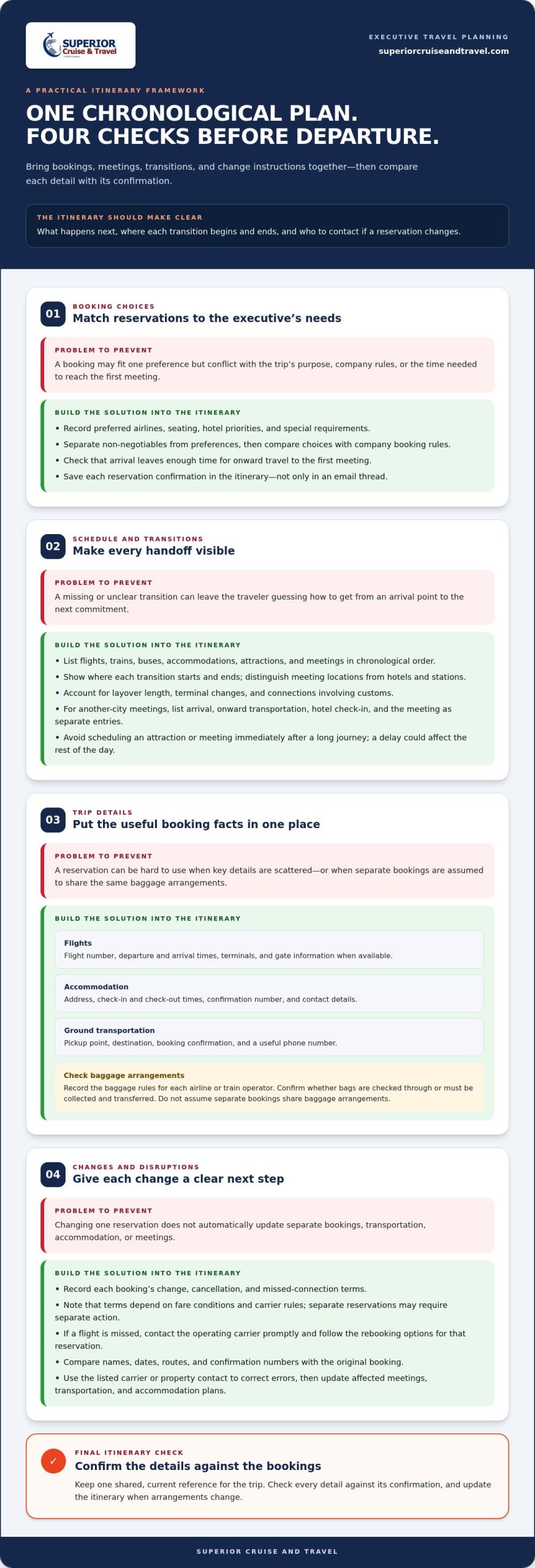
Start with the executive’s recorded preferences, then choose flights, hotels, and ground transportation that suit the trip’s purpose. Note preferred airlines, seating, hotel priorities, and special requirements. Separate non-negotiables from preferences, and compare each choice with company booking rules.
For example, if a direct flight is preferred, check whether its arrival leaves enough time to reach the first meeting. Save the reservation confirmation in the itinerary, rather than relying on an email thread as the only booking record.
-
Coordinate Travel and Meeting Schedules
List flights, trains, buses, accommodations, attractions, and meetings in chronological order. Show where each transition starts and ends, so a meeting location isn’t confused with a hotel or station. When coordinating complex travel itineraries, account for layover length, terminal changes, and connections involving customs.
For a meeting in another city, list arrival, onward transportation, hotel check-in, and the meeting as separate entries. Make sure the transfer fits the schedule. Avoid placing an attraction or meeting immediately after a long journey, because a delay could affect the rest of the day.
-
Record Flight, Stay, and Transport Details
Enter flight numbers, departure and arrival times, terminals, and gate information when available. For each accommodation, record the address, check-in and check-out times, confirmation number, and contact details. For ground transportation, include the pickup point, destination, booking confirmation, and a useful phone number—particularly when coordinating executive travel with premium chauffeur providers like Alphas Elite.
Compare hotel timing with the travel schedule and note any arrangements needed. Record the baggage rules for each airline or train operator. Confirm whether bags are checked through or must be collected and transferred. Don’t assume separate bookings share baggage arrangements.
-
Plan for Changes and Missed Connections
Record each booking’s change, cancellation, and missed-connection terms. These depend on fare conditions and carrier rules, and separate reservations may require separate action. If a flight is missed, contact the operating carrier promptly and follow the rebooking options for that reservation.
To catch reservation mistakes, compare names, dates, routes, and confirmation numbers with the original booking. Use the listed carrier or property contact to correct errors, then update affected meetings, transportation, and accommodation plans. This prevents a change to one booking from being mistaken for an update to the whole trip.
Benefits for time management, stress reduction, and productivity
Use one shared travel system to reduce searching, missed handoffs, and schedule confusion. The steps below connect itinerary tools with practical decisions before, during, and after travel.
- Map multi-leg travel against the executive’s working hours and local time zones. Record each departure and arrival in local time, then show the destination time zone beside meetings. For example, schedule recovery time after an overnight flight before a decision-making session. This makes transitions visible and protects time for focused work.
Compare a multi-city ticket with separate one-way bookings by reviewing the full route, connection time, baggage arrangements, and change conditions. Separate tickets can offer more route choices, but a missed connection may require separate rebooking. Weigh flexibility against the extra coordination each independent booking requires.
- Choose a travel app or shared document that brings together the itinerary, confirmations, and practical tools. Google Sheets can track flight details, while travel apps can consolidate maps, currency conversion, and translation. Send calendar invitations from one coordinating calendar so itinerary updates reach the executive alongside meetings and work commitments.
Keep rental-car pickup instructions, hotel addresses, and meeting locations easy to find. If you are coordinating executive transport through Al Hurr Car Rental or another regional fleet provider, having the collection procedure and booking references immediately accessible prevents delays. A useful template groups information by travel day and destination instead of scattering details across messages. This reduces repeated searches and helps the executive move from one task to the next.
- Record expenses as they occur, not at the end of a demanding trip. Photograph each receipt when received, then categorize it by date and purpose in a receipt-management system. Match it to the relevant trip entry, such as a ground transfer or business meal, to simplify expense reporting later.
After returning, gather remaining receipts, identify unused bookings, and prepare the expense report. A short debrief with the executive can reveal which transfers or schedule choices caused friction. Carry those observations into the next travel template instead of rebuilding the process from memory.
- Decide whether a travel management company fits the trip’s coordination needs. Such a company can provide 24/7 support, while an assistant can manage arrangements in the context of the executive’s priorities and calendar. For a multi-leg trip, define who handles disruptions, itinerary updates, and communication with meeting contacts.
Keep travel protection considerations alongside disruption planning, so the executive can understand how protection relates to the trip. Review travel protection considerations as part of preparing for travel interruptions.
- Estimate planning or app costs by identifying the service scope and tools required. App charges depend on features and subscription terms; professional planning costs depend on itinerary complexity and the support included. Compare what each option manages, such as multi-city bookings, updates, expense records, or disruption coordination, rather than judging by a headline alone.
For a simple route, a shared spreadsheet may cover the essential tracking. A trip involving several cities, time zones, and meeting changes may need more hands-on coordination. Choose support that removes the greatest administrative burden without adding tools you won’t use.
Building flexibility and buffer time into travel plans
Build open space into each travel day, then share one current itinerary with everyone involved. A useful plan gives the executive room to adapt when weather, connections, or opening hours change.
- Separate essential commitments from activities that can move. Mark the meeting that drives the trip, then treat nearby sightseeing or internal work blocks as adjustable. For example, if a client meeting runs late, a flexible attraction visit can shift without affecting the return flight.
Make this distinction clear in the shared itinerary. Label fixed commitments, and show which reservations or activities can change. This gives the executive and trip coordinator a practical order for making decisions when plans shift.
- Leave a 15-minute quiet break in the executive’s schedule when possible. Place it after a demanding meeting or a long transfer, rather than immediately before a fixed departure. That brief pause creates space to review notes, handle an urgent message, or prepare for the next conversation.
Build a longer recovery window around overnight travel or several consecutive meetings. Avoid filling every available minute with calls or visits. Breathing room helps maintain focus when a delay or extended discussion changes the day.
- Use a Transit Day when moving between destinations takes a full day. Treat it as a dedicated travel day, not as a convenient slot for a major meeting or attraction. Add the departure city, destination, and key transfer points so the executive knows what the day involves.
For shorter journeys, compare each connection with the next commitment. A flight arriving before a meeting still leaves time for exiting the airport and reaching the destination. Allow extra time for terminal transfers, security, or customs.
- Share one itinerary showing local times and the latest confirmed plan. Give the executive and relevant colleagues access to the same version, then update it as soon as a booking or meeting changes. A clear revision note helps readers distinguish current arrangements from outdated details.
Include a simple disruption sequence: identify the affected booking, contact the relevant carrier or accommodation, and notify anyone whose plans depend on the change. For instance, a delayed arrival may require adjusting a car pickup and informing the meeting host.
- Preserve options when choosing connections. Searching for flights by individual leg can reveal alternatives when a through itinerary doesn’t fit. Connections on separate airlines may require extra time for terminal transfers or security, so assess the full transfer before choosing that route.
Also allow for weather changes and inaccurate opening hours. Keep a nearby alternative activity or work block available instead of stacking reservations back-to-back. This flexibility helps the itinerary remain useful when the original sequence changes.
Preparing complete itineraries and travel documentation
Build one master reference for the route, documents, and contacts, and keep it current. An assistant can use it to help the executive stay focused as hotels, meetings, and travel arrangements change.
-
Maintain a Master Itinerary Document
Create one chronological document for the full trip, from departure through the return journey. Include each destination, travel segment, accommodation, meeting, and scheduled transfer. Add confirmation details and the local address beside each booking, so readers can find the information without searching email.
Use clear date and destination labels, and distinguish confirmed arrangements from plans still being organized. For example, group a day’s hotel, meeting location, and onward transfer under that destination. Keep one designated version as the master, then share access with the executive and relevant colleagues.
When a flight or meeting changes, update the master document immediately. Add a short note explaining the change and its effect on later arrangements. This helps colleagues avoid outdated copies and keeps the itinerary aligned with current reservations.
-
Gather Emergency Contacts and Important Documents
Prepare a travel pack with the itinerary, booking confirmations, addresses, maps, emergency contacts, local office details, and meeting materials. Arrange the files in trip order, so the executive can quickly find a hotel confirmation or meeting address.
Designate one contact for last-minute changes and travel emergencies, and include their details in the pack. Add relevant carrier, accommodation, transportation, and meeting contacts beside the plans they support. For example, put the hotel contact next to its address, not on a separate page.
Keep essential documents in a secure digital folder, with copies available if the main device or connection is unavailable. Include travel confirmations and the document details the executive needs for the route. Avoid sharing sensitive information broadly; give access only to people involved in the trip.
-
Check Passport, Visa, and Entry Requirements
Review passport validity, visa rules, and vaccination requirements for every country on the itinerary. Check each destination and transit point, since a multi-country route may have different document requirements at every stop. Record relevant requirements and document expiry details in the master itinerary.
For a trip to Canada, Wiley states that all students need valid passports, and foreign students need a visa to exit and return to the United States. Use each traveler’s status and route to organize the document checklist, rather than assuming the same requirements apply to everyone.
Match each document task to the travel sequence: identify what is needed, who must carry it, and when it must be ready. Keep passport and visa details with the travel pack, and flag anything that could affect departure or onward travel. Update the itinerary if the route changes.
Creating travel preferences and booking rules
Written preferences turn individual choices into consistent booking guidance. When coordinating complex travel itineraries, clear rules help an assistant compare options with the executive’s priorities and company policy.
- Ask the executive to rank preferences and non-negotiables for flights and hotels. Record preferred airlines, seating, hotel location, loyalty programs, and meal or accessibility needs. Separate firm requirements from flexible choices: a required arrival time may matter more than a preferred airline.
Keep the profile accessible while booking and note when it was last reviewed. Update it when priorities change, rather than assuming preferences for one destination apply to every trip.
- Set rules based on each trip’s purpose, destinations, dates, timing flexibility, and scheduled meetings. Follow company travel policy, then define acceptable alternatives. For example, specify whether the assistant can select a nearby hotel if the preferred property doesn’t fit the schedule.
Make broad preferences practical. Define what “close to the meeting” means for the trip, or describe the departure window that works best. Specific criteria make booking choices easier to compare and reduce repeated approvals.
- Agree on decision-making authority before booking flights or hotels. State which choices the assistant can make independently and which need executive approval. Give the assistant appropriate access and clear direction for decisions during disruptions.
Document who can approve alternatives, how to reach them, and which trade-offs are acceptable. These details make coordinating complex travel itineraries more consistent when schedules change. For instance, the executive might approve a different departure time to preserve a key meeting.
- Set booking preferences for changing schedules. Favor direct flights when practical, and consider refundable fares when dates are uncertain. Define hotel proximity limits and note whether loyalty benefits or meeting access affect the decision.
For planning, the research guidance recommends booking domestic business flights 4-6 weeks ahead and international business flights 8-10 weeks ahead. Peak season or major events call for booking farther in advance. Weigh route options, meeting dates, and flexibility together.
- Keep a concise rule sheet with preferences, company policy, approval limits, and essential confirmation numbers. Review it before each trip, especially when the destination or meeting schedule differs from previous travel. This keeps an old preference from overriding a current need.
Use the executive’s priorities to shape your next trip plan with Superior Cruise and Travel. Clear booking guidance supports coordinating complex travel itineraries while keeping each decision connected to the trip’s purpose.
Confirm destinations, trip purpose, dates, timing flexibility, and scheduled meetings or events before booking upcoming trips. Executives should provide their Executive Assistant with travel preferences, non-negotiables, appropriate travel-related access, and clear decision-making authority during disruptions.
Superior Cruise and Travel: Luxury Cruises
Superior Cruise and Travel offers luxury cruises for travelers planning an elevated getaway or a longer voyage. Its offerings also include chartered cruise ships, world cruises, and resort vacations, suited to shared group experiences, extended travel, or a relaxing destination stay. If your itinerary involves several business meetings and separate transportation arrangements, use the planning steps above to organize those details. Turn to Superior Cruise and Travel when a cruise or resort vacation is central to your plans. Matching the trip’s purpose to the right travel experience helps clarify which arrangements matter most, from the overall journey to time at the destination. Contact Superior Cruise and Travel to explore its travel offerings.
Choose the experience that will shape your next journey
Let the purpose of your next journey shape the experience. Coordinating complex travel itineraries becomes more intentional when you first decide what you want from the trip, whether that means time at sea, a shared voyage, or an extended exploration. That choice can help set priorities for the route, pace, and people traveling with you.
For a trip centered on the water, Superior Cruise and Travel offers Luxury Cruises, Chartered Cruise Ships, and World Cruises. Consider which format best suits your travel goals, then let that vision guide the details you organize. A clear starting point makes planning more purposeful and keeps the journey connected to what matters most to you.
Explore your cruise travel options with Superior Cruise and Travel and take the next step toward a journey that feels distinctly yours.
Frequently Asked Questions
How can I ensure all details are accurate?
Compare each booking confirmation with the itinerary, one item at a time. Match traveler names, dates, destinations, and confirmation numbers, then verify meeting details against the latest calendar invitation. For example, a flight confirmation may show a different arrival terminal from an older draft. Mark the itinerary’s revision date and remove outdated copies from shared folders so colleagues don’t rely on superseded information.
How do I make travel arrangement as administrative assistant?
Start by clarifying the trip’s purpose, required destinations, meeting commitments, and the executive’s decision-making preferences. Use those priorities to compare booking options, then record approvals and confirmations consistently. For example, distinguish a required arrival time from a preferred airline before presenting choices. Keep the executive’s calendar and travel plan aligned, and note who should be informed if a meeting moves.
What if there are changes in the itinerary?
Update affected arrangements and notify everyone whose plans depend on them. If a meeting moves, review related transportation, accommodation, and other appointments before sharing the revised itinerary. Add a brief change note, such as “meeting location updated,” so readers can see what changed without comparing documents. Mark the old version as outdated instead of leaving multiple active copies in circulation.
What are the change, cancellation, and missed-connection rules for complex itineraries
Change, cancellation, and missed-connection terms depend on fare conditions and carrier rules; separate reservations may require separate action. If a flight is missed, contact the operating carrier promptly and follow the rebooking options for that reservation.