Last Updated: November 26, 2026
Quick Summary
To compare expedition cruise itineraries, start with the destination and route, then check sea days, landing time, ship size, and total trip cost. Use the same worksheet for every option so the differences between routes are easy to see.
- Pick one or two regions first, then compare routes within them.
- Count sea days and days ashore, since more sea days means less time exploring.
- Ask how many landing waves each site allows and how long each guest is ashore.
- Compare total trip cost, including airfare, transfers, hotel nights, and gratuities, not just the fare.
Table of Contents
- How Do You Compare Expedition Cruise Itineraries?
- Start With Expedition Cruise Destinations and Route
- Check Voyage Duration, Sea Days, and Expedition Cruise Landing Time
- How Expedition Cruise Ship Size Shapes Your Itinerary
- Build a Standardized Itinerary Comparison Worksheet
- Compare Total Trip Cost, Inclusions, and Accessibility
- Book Your Expedition With Superior Cruise and Travel
- Frequently Asked Questions
How Do You Compare Expedition Cruise Itineraries?
Comparing expedition cruise itineraries means looking past the brochure headline and checking what each route actually delivers. A useful approach starts with destinations, then works through duration, ship size, landings, and total cost. Expedition cruise itineraries vary more than standard cruises, so a side-by-side method saves time and prevents expensive mistakes.
The short answer: compare routes by destination, time spent exploring, ship characteristics, and what is included in the fare. Then check accessibility and total trip cost before you commit.
Expedition itineraries often promise a region, but the day-by-day plan decides what you will see. Careful comparison shows which trip matches your goals.
Start With Expedition Cruise Destinations and Route
Start with the destination, not the cruise line. Most expedition operators build their brand around particular regions, so a traveler who wants Antarctica should not compare that trip against a Galápagos voyage. A practical approach is to pick one or two regions first, then compare routes within them.
Read each route for its named ports and landing sites. A route that lists Iceland expedition voyages and landings shows different terrain and wildlife than a route built around the Antarctic Peninsula. You can also compare Iceland expedition voyages, landings, and ships side by side. Check whether the itinerary covers a single region or links several, because multi-region routes often mean longer sea days.
Look for the route’s core anchor. Antarctica trips, for example, usually center on the Antarctic Peninsula, while Arctic routes may focus on Svalbard or Greenland. The anchor tells you what the trip is built around. Expedition cruises in Iceland and the Arctic often sail in shorter seasons, so confirm the months before comparing prices.
Check Voyage Duration, Sea Days, and Expedition Cruise Landing Time
Voyage length tells you how much of the trip is spent on land or in the water. A 10-day sailing with four sea days gives you far less time ashore than a 14-day route with two. Count the days in port, the days at sea, and the days on the peninsula or island.
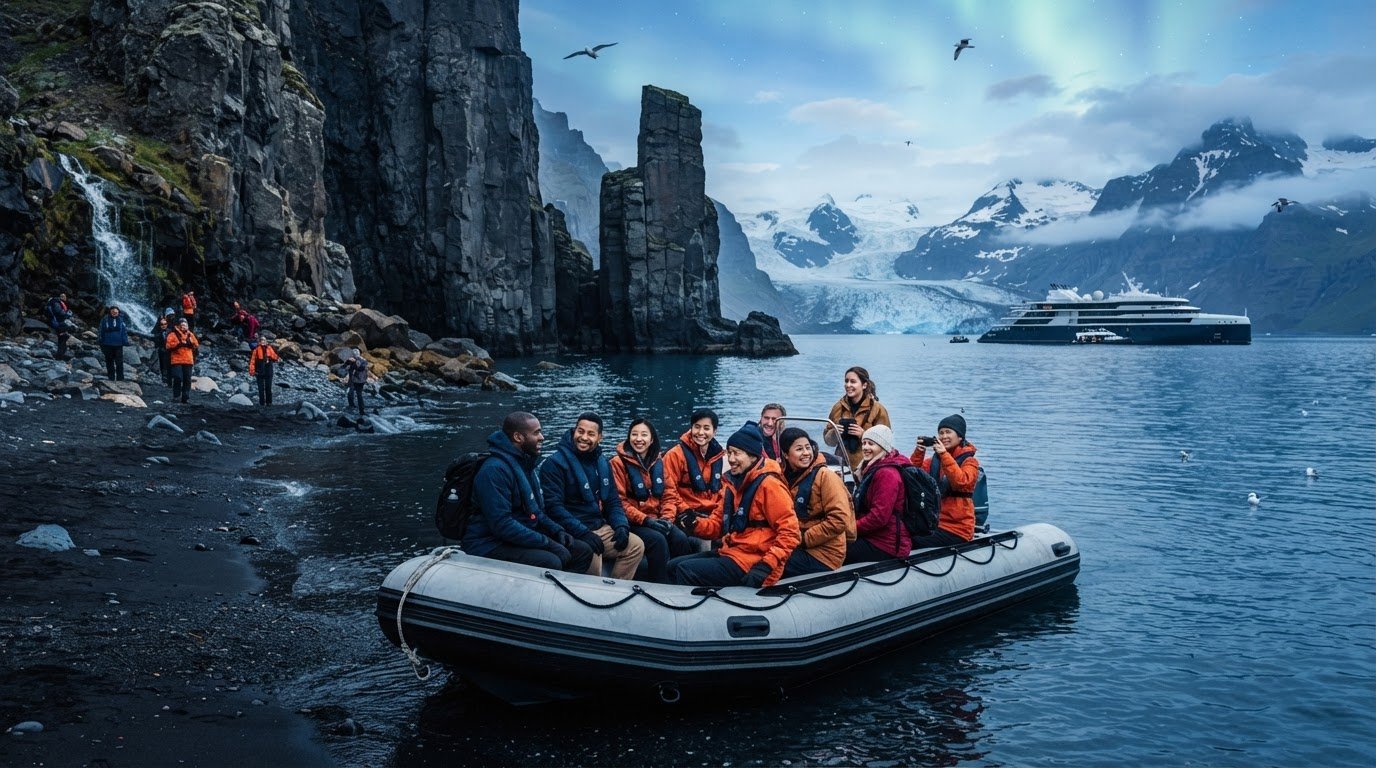
Landing time matters just as much as the number of stops. Two routes can list the same number of landings, but one may offer a single two-hour visit per stop while the other offers a full morning. Ask how many zodiac landings are planned per day and how long each one lasts.
Weather and ice conditions can change the plan. Itineraries are proposals, not guarantees, and expedition ships adjust routes for safety and wildlife. Read the fine print on how the operator handles changed plans.
How Expedition Cruise Ship Size Shapes Your Itinerary
Ship size is the single biggest structural constraint on an expedition itinerary, and it is the factor most travelers underweight. To see how this plays out, you can compare small-ship Alaska voyages against larger expedition options.
Passenger capacity and landing throughput. On a 100-passenger ship, everyone can be ashore at once. On a 200-passenger ship, you land in two waves, which usually means each guest gets one landing slot per site rather than a full morning.
Passenger-to-expedition-staff ratio. The ratio drives how many naturalists are on the zodiac with you, how many optional hikes run concurrently, and how much one-on-one interpretation you get at a wildlife sighting. It also affects safety margins during wet landings. If the ratio is not published, request it in writing.
Zodiac count and staging. This is rarely in the brochure, but it is the mechanical reason two same-length itineraries deliver different amounts of time off the ship.
Ice class and route reach. Ice class determines which routes a ship can actually sail, not just which ones it advertises.
Match ship size to your priority, not to a generic ‘best.’ Travelers rank itineraries differently, and ship size should follow that ranking:
- Wildlife and photography first: favor smaller ships with high staff ratios and flexible zodiac operations, because they can stop for a whale or a bear sighting and hold position. Larger ships are constrained by schedule and volume.
- Remote destinations and ice: favor ice-class vessels, even at the cost of fewer onboard amenities, because reach is the whole point.
- Comfort and sea-day experience: larger expedition ships offer more cabin categories, dining venues, and stability in rough water, which matters on Drake Passage crossings and other exposed transits.
- Limited vacation time: a larger, faster ship may cover more ground in fewer days, but confirm that the extra distance does not come at the cost of landing time.
- Mobility or accessibility needs: smaller ships often mean more manual zodiac boarding and fewer elevators; ask about boarding assistance and deck access before assuming smaller is better.
Build a Standardized Itinerary Comparison Worksheet
Use the same worksheet for every route you consider. Consistent fields make differences obvious. Here is a template you can copy:
Itinerary Comparison Worksheet
- Route name and operator: ____________________
- Region(s) and anchor destination: ____________________
- Total days / sea days / days ashore: ____ / ____ / ____
- Number of landings per day and average landing length: ____________________
- Ship name, passenger capacity, and ice class: ____________________
- Crew-to-passenger ratio: ____________________
- Fare per person (USD) and what it includes: ____________________
- Extra costs (flights, transfers, gratuities, excursions): ____________________
- Physical demands (zodiac boarding, walking, stairs): ____________________
- Season and typical wildlife viewing window: ____________________
| Factor | What to Check | Why It Matters |
|---|---|---|
| Route | Named ports and regions | Shows what you will actually see |
| Sea days | Count of days at sea | Less time ashore if high |
| Landings | Number and length per day | Determines hands-on exploration |
| Ship size | Passenger capacity | Affects access and crowding |
| Crew ratio | Guests per expedition staff | Shapes guidance quality |
| Total cost | Fare plus extras in USD | Reveals true trip price |
Fill in the worksheet for each route, then compare the two or three strongest options side by side.
Compare Total Trip Cost, Inclusions, and Accessibility
The advertised fare is the least useful number on an expedition cruise page. Two fares that differ by a few thousand dollars can reverse order once you add airfare, transfers, pre- and post-cruise hotel nights, gratuities, gear, insurance, and optional excursions. Build a total-cost column for each itinerary, not a fare column.
The cost lines that sit outside the base fare. Most expedition fares cover the voyage, meals onboard, zodiac landings, and expedition staff, but the following commonly sit outside it, and you should price each one for every route you compare:
- Airfare to and from the embarkation point, including any charter flight the operator requires. Some polar operators bundle a charter; others quote it separately, and the difference can be substantial.
- Pre- and post-cruise hotel nights, which are often mandatory when the operator controls the charter schedule.
- Transfers between airport, hotel, and ship.
- Gratuities, which on expedition vessels are frequently suggested per guest per day rather than included.
- Expedition gear, such as parkas, boots, and waterproof pants, some operators loan boots and provide a parka, others do not.
- Optional activities, including kayaking, camping, snowshoeing, and helicopter or submersible experiences, which are usually priced per person per outing.
- Travel insurance, including medical evacuation coverage, which many polar operators require as a condition of boarding.
- Visa and entry fees, where applicable to the route.
A practical method: for each itinerary, write the fare, then add a single “extras” line built from the eight items above. Compare the two totals, not the two fares. Guide to expedition cruise fare inclusions is a useful cross-check on which costs commonly sit outside the base price.
Accessibility and physical demands vary by itinerary, not just by ship. The same operator may run a gentle peninsula route and a demanding crossing that are not interchangeable for a traveler with limited mobility. Compare itineraries on these dimensions:
- Landing type: wet landings require stepping into shallow water from a zodiac; dry landings let you step onto a beach or pier. A route with mostly wet landings is harder for anyone with balance or mobility concerns.
- Zodiac boarding: boarding from a ship’s marina platform is easier than boarding by ladder from a lower deck. Ask which method each ship uses.
- Terrain and walking distance: some sites are flat beach walks; others are steep tundra or scree. Ask for the typical hike length and elevation gain per landing.
- Activity intensity: kayaking, camping, and long hikes add physical demand and usually require a sign-up and sometimes a fitness declaration.
- Ship accessibility: elevators, cabin door widths, and bathroom grab bars vary widely on older expedition vessels.
A decision framework for different traveler priorities. Rather than asking which itinerary is best, rank your own priorities and let the ranking drive the comparison:
- Wildlife first: weight landing count and staff ratio above cabin category.
- Photography first: weight time ashore, flexibility to hold position, and light-friendly scheduling.
- Remote destinations first: weight ice class and route reach above onboard comfort.
- Comfort first: weight cabin size, dining, and stability above maximum landings.
- Limited vacation time: weight sea days and transfer time heavily, since a route with many sea days delivers less exploration per day off work.
Budget for the full trip, not the fare alone. Pricing depends on dates, cabin category, and route, so request a current quote from Superior Cruise and Travel rather than relying on estimates.
Watch out: an itinerary that looks cheaper per day can cost more per hour actually spent ashore once sea days, transfer days, and mandatory hotel nights are counted, calculate cost per landing day, not cost per calendar day.
Book Your Expedition With Superior Cruise and Travel
Comparing itineraries is easier with a clear worksheet and a full cost picture. Superior Cruise and Travel can help travelers match routes to their priorities, from destination and ship size to accessibility and budget. Superior Cruise and Travel offers personalized, full-service vacation planning without any service fees.
Frequently Asked Questions
What is the best expedition cruise line?
No single line is best for everyone. The right choice depends on where you want to go, how much time you have ashore, the size of the ship you prefer, and your budget. Start by listing your must-see destinations, then compare which operators run itineraries that reach them. Compare landing opportunities, crew-to-passenger ratios, and what is included in the fare. Working through those factors usually narrows the field to two or three options that fit your priorities.
How do you compare expedition cruise itineraries?
Compare itineraries side by side using the same criteria: destinations and route, total voyage days, days on the peninsula or in the main region, expected shore landings, sea days, ship size, and the activities included. Note whether the published plan is a fixed schedule or a flexible plan, since weather and ice often change the actual days ashore. Recording these items in a simple worksheet makes differences between voyages easy to see.
How much time do expedition cruises spend ashore?
Time ashore varies widely by itinerary, season, and ship. Some voyages offer landings most days, while others include long sea crossings with fewer opportunities to go ashore. Ask each operator for the expected number of landings and the typical time on shore per day, and remember that these are estimates. Weather, ice, and wildlife can change the plan on any given day.
How does ship size affect an expedition cruise itinerary?
Smaller ships can usually reach more remote anchorages and make more landings, because fewer passengers need to be moved ashore at once. Larger ships may offer more onboard amenities but often have fewer landings and more reliance on larger shore operations. When comparing itineraries, check the ship’s passenger capacity and how many landings a voyage plans, not only the destinations listed.