A new ship’s contemporary, premium or luxury christening ceremony is more than a bottle broken over the bow. It may include a blessing, performances and a first look at the ship’s inaugural voyage plans, with traditions shaped by the cruise line and occasion.
A christening is a memorable milestone, and it’s natural to wonder what the rituals mean and how the celebration relates to the ship’s first sailings. Details vary, but the central purpose is to mark the ship’s arrival and wish it well as it enters service.
This guide explains what may happen, from blessings and bottle breaking to onboard festivities, and how inaugural destinations and schedules fit into the picture. Whether you’re curious about the ceremony or considering a sailing on a new ship, you’ll learn what to expect and what to look for in cruise announcements.
Key Takeaways
- Learn how a ship’s christening relates to its first sailing, so you can follow the transition from ceremony to inaugural voyage.
- Recognize the meaning a blessing can bring to a ship’s launch and how religious traditions have appeared in maritime ceremonies.
- Understand the bottle-breaking ritual and the sponsor’s role in making the moment memorable.
- See how the chosen christening liquid and celebratory program can shape the character of the event.
- Explore how Superior Cruise and Travel can help you plan a luxury cruise around an upcoming ship or sailing.
Inaugural voyage destinations and schedule
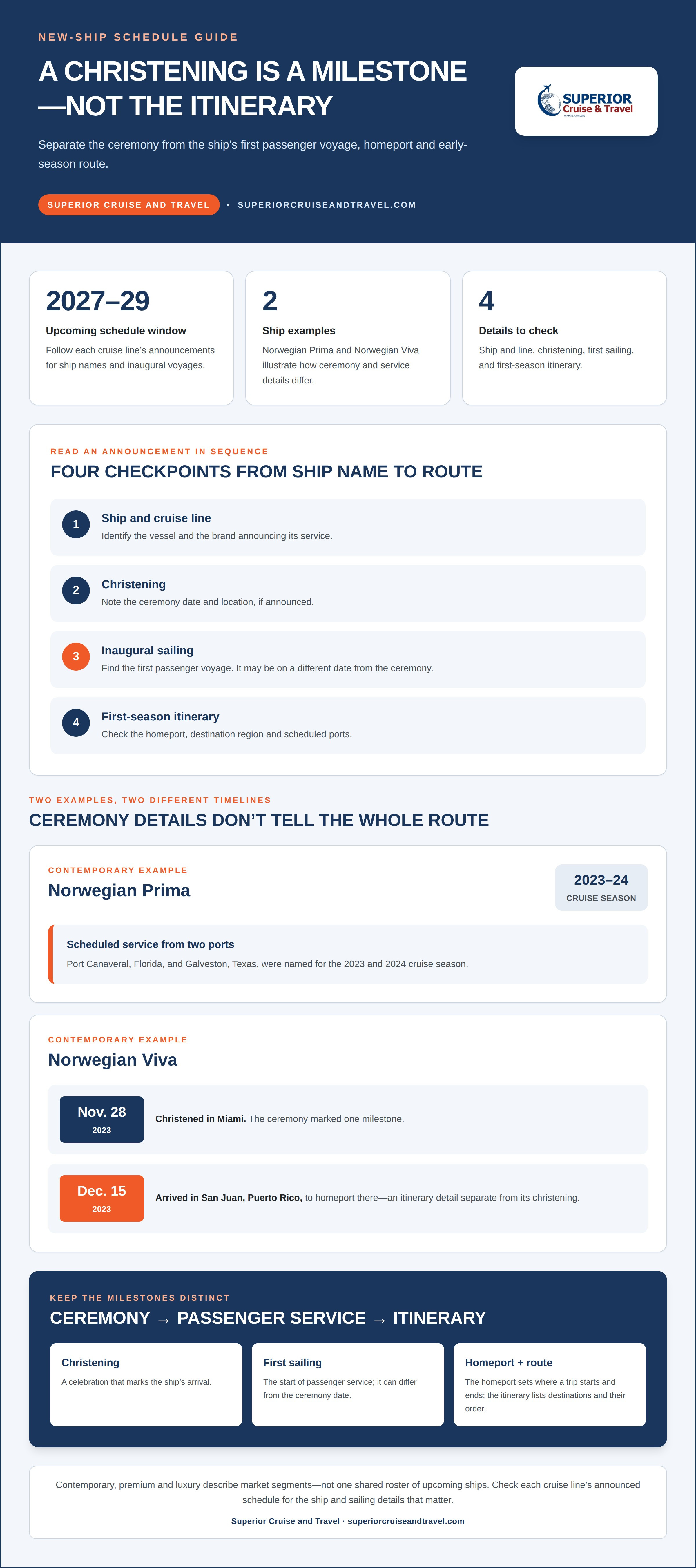
For 2027, 2028 and 2029, follow each cruise line’s announced new-ship schedule for vessel names and inaugural voyages. Contemporary, premium and luxury are useful segment labels, but they don’t identify one shared roster of upcoming ships.
Cruise lines use contemporary, premium and luxury to describe market segments, not a universal classification. Norwegian Prima and Norwegian Viva are examples of ships associated with contemporary cruising.
A christening date and an inaugural sailing date mark different milestones. Norwegian Prima was scheduled to serve Port Canaveral, Florida, and Galveston, Texas, for the 2023 and 2024 cruise season. Norwegian Viva was christened in Miami on Nov. 28, 2023, then arrived in San Juan, Puerto Rico, on Dec. 15, 2023, to homeport there. These examples show why it helps to distinguish a ceremony from a ship’s itinerary.
When reviewing an announcement about a future ship, separate the details into a simple sequence:
- Ship and cruise line: Identify the vessel and the brand announcing its service.
- Christening: Note the ceremony date and location if announced.
- Inaugural sailing: Find the first passenger voyage, which may differ from the ceremony date.
- First-season itinerary: Look for the homeport, destination region and scheduled ports.
This helps avoid a common mix-up: the christening location doesn’t necessarily indicate where the ship’s first voyages will begin. Norwegian Prima’s scheduled service from Florida and Texas illustrates the distinction. Norwegian Viva’s arrival in San Juan shows how a homeport can also feature in a ship’s early schedule.
For an upcoming sailing, the homeport matters because it determines where the trip starts and ends. A voyage based in San Juan differs logistically from one serving Port Canaveral or Galveston. The itinerary then sets out the destinations the ship visits and their order.
Compare experiences by looking at schedule details, not just launch dates. A christening is a celebration; an inaugural voyage begins passenger service. Norwegian Prima and Norwegian Viva show why a clear ship timeline should distinguish both milestones and the destination plan. These distinctions help you identify which announcement answers your question about future contemporary, premium or luxury sailings.
Norwegian is represented by contemporary examples Norwegian Prima and Norwegian Viva; no premium or luxury cruise line is identified.
Blessings and religious ceremonies
For an upcoming christening, the cruise line or ship’s organizers choose a godmother or godfather as ceremonial sponsor. Their role is distinct from that of clergy, who may lead a blessing depending on the event.
A delay can affect the ceremony’s timing, venue access or sequence, while a cancellation can remove the public event from the schedule. Organizers may adapt the timing or format; the ship’s readiness and the reason for the disruption shape the practical response.
Religious blessings connect ship christenings with maritime traditions that reach back thousands of years. A Babylonian narrative dating from the 3rd millennium BC describes a completed ship and sacrifices to the gods. That account shows how a vessel’s launch could be marked by ritual, not simply by its physical entry into the water.
In 1675, Knights of Malta clergy prayed aboard a 23-oar brigantine and sprinkled it with holy water before launch. The example combines spoken prayer with a physical blessing of the vessel. Modern ceremonies may also include a religious element, although the exact form depends on the occasion and those organizing it.
A blessing and bottle breaking may feature in the same event, but they have different symbolic purposes. A prayer or blessing expresses a wish for protection and safe passage. The naming ritual marks the ship’s identity and entry into service. Some christenings include both; others focus on one tradition or a broader celebration.
Norwegian Viva was christened in Miami on Nov. 28, 2023. The date offers a recent example of a named cruise ship’s ceremony, while the historical accounts show how varied these rituals can be. A contemporary, premium or luxury ship’s event may bring together a religious leader, a sponsor and invited guests, with the ceremony’s format shaped by the cruise line.
For guests, distinguish the spiritual portion from the wider event schedule. A blessing may take place before the ship is named, during a formal program or as part of a larger gathering. If the program changes, follow the revised start time, location and sequence. These details affect attendance, while the ship’s inaugural itinerary is a separate planning matter.
When considering a future sailing, treat the christening as a meaningful occasion, not a required part of the voyage. The ship may begin passenger service on a different date or itinerary from its ceremony. Keeping those events separate helps put religious traditions, event logistics and travel plans in perspective.
The cruise line or ship’s organizers choose a godmother or godfather as ceremonial sponsor; the sponsor depends on the event.
Breaking a bottle over the bow
For passenger ships, naming and bottle breaking are traditions, not a universal script. A sponsor may name the vessel and break a bottle against its bow, while the organizers shape the event. A new ship’s contemporary, premium or luxury christening ceremony can draw on these customs without following an identical format.
The bottle marks a public welcome: guests witness the ship receive its name. In the United States Navy practice described here, the sponsor breaks a champagne bottle on the ship’s bow. The sponsor’s role may continue beyond the event, as Navy sponsors remain in contact with the crew.
The custom has a documented history in the United States. The first known instance of a woman sponsoring a United States Navy vessel was the 1828 launch of the sloop of war Concord, christened by a young woman from Portsmouth. That example predates the first identified woman sponsor by eighteen years.
On August 22, 1846, Lavinia Fanning Watson became the first identified woman sponsor of a United States Navy vessel. She broke a bottle of wine and water over the sloop-of-war Germantown in Philadelphia. Her example shows that champagne isn’t the only liquid associated with a naming ritual.
A contemporary, premium or luxury christening ceremony for a new ship can be understood through three symbolic moments:
- Gather: Guests witness the event as the ship and its name are presented.
- Name: The sponsor takes part in the formal naming moment.
- Break: The bottle is released against the bow, marking the occasion.
This sequence explains the symbolism without implying that every cruise line follows the same steps. The Concord and Germantown examples reflect United States Navy traditions, while passenger-ship christenings are arranged by their organizers. The sponsor, wording and bottle choice can differ from one ceremony to another.
For guests, distinguish the sponsor’s ceremonial role from the ship’s operational plans. The bottle-breaking marks the christening; on its own, it doesn’t tell you when passenger service begins. When following an announcement about a new ship, keep the ceremony date separate from the inaugural sailing date.
When watching a future ceremony, notice who names the ship and how the bottle ritual is presented. Lavinia Fanning Watson’s role and the Navy sponsor tradition provide historical context, while each new ship’s event has its own program. A broken bottle is a recognizable symbol, not a guarantee that every christening will look the same.
In recent United States Navy practice, sponsors are female, break a champagne bottle on the ship’s bow during the ceremony and remain in contact with the crew. That continuing contact extends the sponsor’s role beyond the public naming moment, while bottle breaking remains part of the ceremony. These details offer a point of comparison with passenger-ship events, whose organizers may shape the ceremony differently.
Champagne and other christening liquids
Champagne is a familiar choice for a ship’s bottle-breaking moment, but it isn’t the only liquid associated with christenings. Historical practice also includes wine and water, showing that the liquid can carry meaning beyond the celebratory image of sparkling wine.
Contemporary, premium and luxury are cruise-market labels, not rules for christening rituals. A ship’s segment alone doesn’t determine whether its ceremony uses champagne, another wine or water. The cruise line and event organizers shape each ship’s program.
The liquid is one part of a larger visual ritual. The sponsor’s gesture, the bottle and the ship’s bow create a moment guests can recognize. The choice may complement a formal naming, a blessing or a broader celebration, but it doesn’t define the ship’s category or inaugural itinerary.
Wine and water offer a useful contrast with champagne. Wine can retain the celebratory association of bottle breaking, while water can connect the gesture with a blessing or maritime symbolism. These choices show why the liquid at a christening need not be viewed as a beverage selection alone.
For ship organizers, the decision is how the liquid fits the ceremony’s tone and sequence. A bottle used during a formal naming can create a different impression from one used alongside a religious blessing. Since the bottle’s role is symbolic, the program should make clear what the gesture represents.
Guests can understand the moment by noticing three elements:
- The liquid: Champagne, wine or water signals the ceremony’s chosen tradition.
- The gesture: The sponsor’s action gives the bottle its ceremonial meaning.
- The setting: The bow places the ritual visibly within the ship’s christening.
These elements help explain why two ships in the same segment may have different ceremonies. One event may emphasize bottle breaking; another may focus more on a blessing or performance. The liquid choice belongs to the program, not to a fixed definition of contemporary, premium or luxury cruising.
When following announcements about new ships, separate the ceremony’s symbolism from practical voyage details. Champagne or another liquid marks a christening moment; it doesn’t tell you when passenger sailings begin or which destinations are on the itinerary. Treat the naming event and inaugural schedule as related milestones, but distinct parts of a new ship’s introduction.
For a future christening, ask what the chosen liquid means within that event. Champagne may signal celebration, while wine or water can reflect different traditions. The ceremony’s sequence and the sponsor’s role help explain the choice without assuming every cruise line follows the same script.
Christening performances and celebrations
A ship christening may pair the formal naming with performances and a broader celebration. Music, speeches and staged entertainment can welcome guests, while the bottle breaking or blessing remains a central ceremonial moment. The organizers set the program, so one ship’s celebration isn’t a template for every cruise line.
The public can watch when organizers provide a livestream, as happened with the Harrisburg (LPD 30) christening. Its ceremony was streamed live on Jan. 11, 2025. The livestream was scheduled to begin at 9:45 A.M., and the ceremony was scheduled to begin at 10:00 A.M. CST. These separate times show why viewers should distinguish a broadcast start from the ceremony’s start.
A performance program can serve several purposes. An opening welcome provides context, a musical interlude marks a transition, and a closing celebration turns attention to the ship’s next chapter. These are possible program elements, not details attributed to Harrisburg. For a specific event, the published schedule is the clearest guide to what viewers will see.
Christenings may take place in different settings, including at a port or aboard the vessel. The location shapes the atmosphere and what guests see; the program determines how the naming and celebrations unfold. A ceremony beside the vessel, for example, makes the ship itself part of the visible occasion.
To follow an upcoming ceremony, use this simple viewing sequence:
- Find the event notice: Look for the ship name, ceremony date and viewing format.
- Separate the start times: Identify when a livestream begins and when the ceremony starts.
- Read the program: Note any listed performances, speeches or naming rituals.
- Follow the broadcast: Use the viewing details provided for that specific event.
In-person attendance depends on the event’s access arrangements, while a livestream can let viewers watch from elsewhere. The Harrisburg broadcast shows that a christening can be viewed remotely; it doesn’t mean every event offers public access or a stream. For a future ceremony, the organizer’s notice sets out the available viewing options.
Performances add atmosphere, but they don’t replace the ship’s naming or signal that passenger service has begun. Keep the ceremony program separate from the inaugural sailing schedule when planning around an upcoming ship. If a new vessel inspires your next trip, explore upcoming cruise options.
Norwegian Prima was christened in Reykjavik, Iceland, on Aug. 27, 2022. The example places the naming ceremony in a specific destination, but the location alone does not establish which performances or other celebrations took place. Those details depend on the program announced for the event.
For a christening in a destination setting, look for information about both the ceremony and its surroundings. The location may provide a distinctive backdrop, while scheduled performances shape the occasion’s pace and mood. Keep these details separate: the setting tells you where the ceremony happens, and the program describes what organizers have planned. For a particular ship, rely on its event notice for confirmed details rather than assuming another christening’s format will be repeated.
Superior Cruise and Travel: Luxury Cruises
Superior Cruise and Travel can help turn interest in an upcoming ship into a thoughtful cruise plan. If you’re choosing between a new ship’s inaugural sailing and a later itinerary, start with its Luxury Cruises offering and plan around the voyage that suits your travel goals.
For a longer journey, explore World Cruises or Grand Voyages; for a private group experience, consider Chartered Cruise Ships. The right fit depends on the kind of trip you want, from a first-season sailing to an extended voyage.
Contact Superior Cruise and Travel to discuss your next cruise plans.
Make Your Next Sailing the Right Fit
A new ship’s christening can inspire a future voyage, but the best trip for you depends on more than the ceremony. Consider how the route, departure port and timing fit your plans, then decide whether you want the energy of a new vessel or a longer journey built around discovery. A contemporary, premium or luxury christening ceremony can introduce a ship memorably; the sailing itself is where your travel priorities take shape.
Superior Cruise and Travel offers Luxury Cruises, Chartered Cruise Ships and World Cruises, giving you different ways to experience the water. Whether you’re considering an upcoming itinerary, planning a private group voyage or dreaming of an extended journey, start with the experience you want from your next trip.
Contact Superior Cruise and Travel to discuss your next cruise plans. Your future voyage begins with a possibility worth exploring.
Frequently Asked Questions
What are the christening dates and locations for newly launched cruise ships?
Each ship has its own christening date and location, set for its event rather than a shared industry calendar. For an upcoming ship, use the cruise line’s announcement to identify the ceremony’s venue and date. Keep those details separate from the ship’s first passenger sailing: the ceremony may take place in a different port from the voyage’s departure point.
What happens during a cruise ship christening ceremony?
A cruise ship christening typically centers on naming the vessel, with a sponsor taking part. The program may also include a blessing, bottle breaking, speeches or performances. Public access varies by event; an announcement may provide attendance information or a livestream schedule. If you plan to watch remotely, note whether the listed time is for the broadcast or the ceremony itself.
How do christening traditions differ among contemporary, premium, and luxury cruise lines?
Contemporary, premium and luxury christenings may use familiar customs, such as a sponsor naming the ship and breaking a bottle, but there’s no single script. The blessing and wider celebration vary by event and organizer.
What new cruise ships are launching soon in the contemporary, premium, and luxury segments?
For 2027, 2028 and 2029, follow each cruise line’s announced new-ship schedule. Norwegian Prima and Norwegian Viva are contemporary examples, but the article does not identify them as upcoming ships.