
What if the price tag you see on a luxury yacht listing is only sixty percent of what you’ll actually pay by the time you step off the deck? Understanding the average cost of a private yacht charter is often the most complex part of planning a dream getaway. You might feel overwhelmed by the gap between an attractive base rate and the final invoice. It’s natural to worry that hidden expenses or shifting tax structures in destinations like Greece or Croatia will turn a relaxing escape into a series of financial surprises.
We believe that your journey should be defined by the beauty of the horizon, not by the complexity of the fine print. This comprehensive guide breaks down exactly how to budget for your 2026 voyage, from the Advance Provisioning Allowance to specific regional VAT differences. You’ll gain a clear, line-item understanding of every expense, ensuring you can choose the right charter model with total confidence. We’ll explore base rates, seasonal price fluctuations, and the logistical details our seasoned experts handle so you can focus entirely on the experience ahead.
Key Takeaways
- Learn why a shipyard’s reputation and the vessel’s size form the foundation of your quote, covering the yacht and crew before any additional expenses are applied.
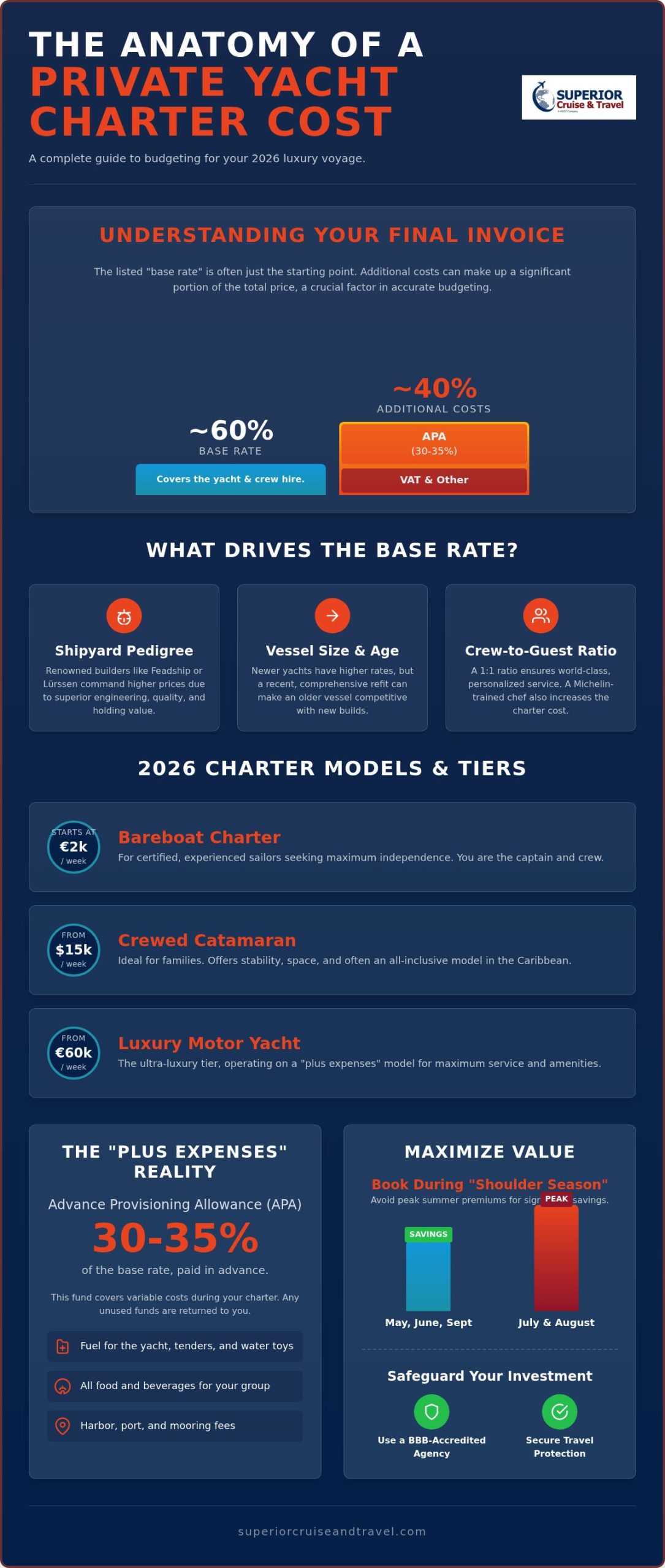
- Discover how the average cost of a private yacht charter includes the Advance Provisioning Allowance, which typically adds 30 to 35 percent to the base rate for fuel and food.
- Identify the significant savings available by booking during the shoulder season months of May, June, or September to avoid the high premiums of peak summer.
- Distinguish between bareboat and fully crewed models to select the specific level of service that best aligns with your vision for the perfect voyage.
- Understand why partnering with a BBB-accredited agency and securing travel protection are essential steps to safeguard your investment and ensure the highest crew standards.
Understanding the Base Rate: What Drives Private Yacht Charter Pricing?
Planning a voyage begins with understanding the “Base Rate.” This figure is the foundational price for hiring the vessel and its professional crew. It’s important to remember that this rate doesn’t include your food, beverages, fuel, or harbor fees. When you’re looking into the average cost of a private yacht charter, you’ll quickly notice that two yachts of the identical length can have vastly different prices. This discrepancy usually comes down to the yacht’s pedigree, its age, and how recently it was refitted to modern standards.
Yacht chartering markets in 2026 place a high value on shipyard reputation. Names like Feadship or Lürssen are the gold standard of the industry. These builders create vessels with superior engineering and quiet operation that hold their value for decades. A yacht built in 2024 will naturally command a higher price than one from 2018, but a comprehensive refit can bridge that gap. If a 2015 vessel has new interiors and updated engine systems, its market value remains competitive with newer builds.
You might think that a yacht with more cabins would lower your per-person expenses, but the opposite is often true. Larger guest capacities usually require a more substantial hull and a larger crew to maintain a luxury service level. This increases the base rate, meaning that a 12-guest yacht may be significantly more expensive than an 8-guest vessel of the same pedigree.
Vessel Type: Catamarans vs. Motor Yachts
Sailing catamarans serve as a wonderful value entry point for families and groups. Their dual-hull design provides exceptional stability and expansive deck space without the massive fuel requirements of a power vessel. In contrast, motor yachts carry higher base rates due to their complex machinery and larger staffing needs. Many high-end motor yachts now feature “zero-speed stabilizers.” These advanced systems use active fins to eliminate the rolling motion of the sea while the yacht is at anchor, ensuring your comfort remains undisturbed even in choppy waters.
The Pedigree and Crew Ratio Premium
The hallmark of a true luxury experience is the crew-to-guest ratio. We often recommend yachts that maintain a 1:1 ratio, ensuring that every request is met with immediate, personalized attention. This level of service is what transforms a simple boat trip into a world-class holiday. The expertise in the galley also influences the price. You’ll find a clear price distinction between a yacht with a standard ship’s cook and one featuring a Michelin-trained culinary team. Pedigree in yachting is the combination of shipyard prestige and crew longevity.
Charter Models: Bareboat, Crewed, and Luxury Tiers in 2026
The average cost of a private yacht charter depends heavily on the level of service and autonomy you desire for your time at sea. For experienced sailors with the necessary certifications, bareboat charters offer the most independence. In 2026, weekly rates for these vessels typically start between €2,000 and €8,000. However, most of our clients prefer the pampered experience of a fully crewed charter, where every detail from navigation to gourmet dining is handled by professionals. If you’re interested in the yachting lifestyle but aren’t ready to book an entire vessel, “by-the-cabin” charters provide a perfect bridge. You might also consider a luxury yacht charter marina del rey for a high-end, all-inclusive excursion that allows you to enjoy the intimacy of a private vessel without the commitment of a full week at sea.
Crewed catamarans have become the most popular choice for family reunions and small groups due to their stability and impressive living space. In the Caribbean, these often operate on an “all-inclusive” model, which simplifies your budgeting by covering the crew, meals, and standard beverages in the initial price. For a 50 to 60-foot catamaran, you can expect the average cost of a private yacht charter to range from $15,000 to $45,000 per week. This predictable pricing structure is a significant advantage for those who want to relax without tracking individual expenses for fuel or provisions during their stay.
The Ultra-Luxury Tier: Motor Yachts and Mega-Yachts
As you move into the world of motor yachts, the pricing structure shifts to “plus expenses,” where you pay a base rate for the vessel and crew, then cover operating costs separately. For yachts between 30 and 50 meters, base rates for 2026 generally fall between €60,000 and €200,000 per week. If your vision includes a mega-yacht over 150 feet, the weekly tier often starts at $200,000 and can quickly climb into the millions for world-renowned vessels.
We’re also seeing a rising premium for “Explorer Yachts,” which are specifically engineered to reach remote destinations like the Arctic or the deeper reaches of the South Pacific. These rugged vessels offer the same luxury amenities as traditional motor yachts but with enhanced range and specialized tenders. To ensure your journey is seamless from the moment you leave home, we often coordinate these high-end bookings with private jets, allowing you to bypass commercial terminals and arrive directly at the marina ready to board.
The ‘Plus Expenses’ Reality: Understanding APA and Hidden Costs
One of the most frequent points of confusion regarding the average cost of a private yacht charter is the “plus expenses” contract model. While the base rate covers the vessel and its crew, the Advance Provisioning Allowance (APA) serves as your dedicated operating budget for the week. Think of it as a simple, transparent account that covers your fuel, food, beverages, and harbor fees. For 2026, we recommend budgeting between 30% and 35% of your base rate for the APA to ensure your captain can meet every request without financial friction.
Transparency is a cornerstone of the luxury yachting experience. Your captain acts as a meticulous bookkeeper, maintaining a clear ledger of every expense incurred during your voyage. At any point, you can request an update on your remaining balance, and at the end of the trip, you’ll receive a full folder of itemized receipts. If you spend less than the deposit, the remaining funds are returned to you in full. Conversely, if you decide to extend your itinerary or host an elaborate party on deck, you can simply top up the account to keep the service seamless.
Fuel often represents the largest variable within your APA. It’s helpful to understand that consumption varies wildly based on your lifestyle choices at sea. While sitting at anchor in a quiet cove uses very little fuel to run the generators and air conditioning, high-speed cruising to reach a distant island by sunset can consume hundreds of gallons per hour. Discussing your preferred pace with your broker helps us provide a more accurate estimate before you even step on board.
VAT and Local Taxes by Destination
Taxation is a complex layer of yachting that varies significantly by where you choose to drop anchor. In the Mediterranean, VAT rates are a standard consideration, with Greece currently at 24% and Italy and Croatia maintaining their own specific structures for 2026. In contrast, many Caribbean destinations are tax-neutral, though they often require specialized cruising permits or national park fees that are paid through your APA. VAT is always calculated on the base rate, not the APA.
Dockage Fees and Provisioning Premiums
The cost of “being seen” in the world’s most glamorous ports can impact your final budget. Securing a prime berth in St. Tropez or Ibiza during the peak of July carries a premium dockage fee that is significantly higher than anchoring out in a bay. Similarly, your taste in provisioning plays a role. If your vision for the trip includes rare vintages or specific delicacies imported from across the globe, these special requests will naturally draw more from your provisioning allowance. Our team coordinates these details with the crew months in advance to manage these costs effectively and ensure your favorites are waiting in the galley.
Regional and Seasonal Fluctuations in Yachting Costs
Timing is everything when you’re calculating the average cost of a private yacht charter. If you’ve ever looked at a calendar and wondered why prices spike during specific months, you’re observing the natural rhythm of the global yachting world. High-season months like July and August in the Mediterranean or December and January in the Caribbean command premiums of 20 to 40 percent. This isn’t just a matter of demand. It’s about the exclusive availability of the finest vessels during the most desirable weather windows of the year.
There’s a well-kept secret to maximizing your value without sacrificing the luxury experience. We often guide our clients toward the “shoulder seasons” of May, June, and September. During these windows, the weather is typically just as beautiful, the coastal towns are less crowded, and the base rates are significantly more accessible. If your heart is set on a specific global event, such as the Monaco Grand Prix or the Cannes Film Festival, you should prepare for “Event Charter” surcharges. These prestigious weeks require specialized contracts and often involve higher dockage fees due to the global spotlight on the harbor.
Mediterranean High-Season Dynamics
In the Mediterranean, the 2026 summer season is already seeing impressive demand. Limited berth availability in iconic ports like Portofino or Mykonos means that the cost of your voyage is as much about the location as the vessel itself. We recommend booking your 2026 summer voyage at least 12 to 18 months in advance to secure your preferred yacht and itinerary. For those who find a single week isn’t enough to satisfy their wanderlust, comparing these private experiences with World Cruises and Grand Voyages can help you decide which scale of exploration fits your long-term travel goals.
Caribbean and Bahamas Pricing Standards
The Caribbean offers a different financial landscape altogether. While the US Virgin Islands often favor an all-inclusive model, the Bahamas and British Virgin Islands frequently shift toward a plus-expenses structure. Logistics in the Bahamas can be more complex, often leading to slightly higher operational costs than in the more compact USVI. You should also consider repositioning fees. If you wish to start your journey in St. Maarten and end in Antigua, the yacht may charge a fee to return to its home port. A growing trend for 2026 is the “dual-season” yacht, which migrates between the Med and the Caribbean. This increases year-round availability but requires precise timing to catch the vessel as it arrives in its new region.
To find the perfect balance between luxury and value for your next trip, speak with our expert charter hosts today.
Maximizing Value: Why a Luxury Travel Agency is Essential for Charter Success
While calculating the average cost of a private yacht charter is the first step in your journey, the true value of a voyage lies in its seamless execution. A six-figure travel investment requires more than just a digital booking engine; it demands the oversight of a seasoned partner who understands the high stakes involved. As a BBB-accredited agency, we act as your protective advocate, vetting crew reputations and shipyard histories that aren’t visible on a standard brochure. This professional vetting ensures that the high standards you expect are met from the moment you step on deck until your final departure.
We bridge the gap between abstract planning and practical execution by coordinating the “Total Experience.” This often involves arranging private jets to the marina, securing pre-cruise resort stays, and handling the complex dockside logistics that can overwhelm even the most experienced travelers. If a dispute arises over an itemized APA receipt or a specific contract nuance, our team handles the negotiations on your behalf. We manage the complexities of the task so you can remain focused on the horizon, maintaining the stress-free atmosphere that defines a luxury holiday.
Travel Protection and Risk Management
Investing in a private charter involves significant financial commitments, making travel protection a non-negotiable part of the planning process for 2026. We strongly recommend “Cancel for Any Reason” policies to safeguard your investment against unforeseen changes. It’s vital to distinguish between the yacht’s own insurance, which covers the vessel itself, and personal travel protection, which covers your specific financial risks. This multi-component planning approach, which we detail in our Ultimate Guide to Planning Luxury Cruise Vacations, offers a level of security that single-component bookings simply cannot match.
The Superior Cruise and Travel Advantage
Our global supplier network allows us to find “off-market” yacht availability that isn’t listed on public databases, giving you access to the most exclusive vessels for the upcoming season. If a mechanical failure occurs or a crew member becomes unavailable, our professional advocacy ensures that solutions are found quickly and fairly. We serve as the bridge between your grand vision and its flawless execution, ensuring that the average cost of a private yacht charter translates into a priceless experience for you and your guests.
Contact Superior Cruise and Travel to start your 2026 private charter consultation today.
Setting Sail for Your 2026 Voyage
Navigating the financial landscape of luxury yachting becomes a seamless journey when you understand the mechanics behind the “plus expenses” model and the strategic value of seasonal timing. We’ve explored how the average cost of a private yacht charter is built on a foundation of shipyard pedigree, professional crew service, and a transparent operating budget through the APA. By choosing the right vessel and leveraging the quiet beauty of the shoulder seasons, you can enjoy a world-class experience that aligns perfectly with your aspirations and your financial intelligence.
Your peace of mind is our highest priority throughout this complex planning process. As a BBB-accredited agency with a global network of elite yacht suppliers, we handle every logistical detail so you don’t have to. We also ensure your investment is secured with comprehensive travel protection, allowing you to look forward to your departure with total confidence. The horizon is waiting, and we’re here to serve as your expert host every step of the way.
Plan Your 2026 Private Yacht Charter with Superior Cruise and Travel today and let us transform your vision into a flawless reality.
Frequently Asked Questions
What is the average cost of a private yacht charter for a week?
The average cost of a private yacht charter varies significantly based on the vessel’s size and style. For 2026, weekly rates for bareboat sailing yachts typically start between €2,000 and €8,000. In contrast, crewed motor yachts often range from €20,000 to €200,000, while superyachts can exceed €500,000. These figures represent the base rate only. Our team helps you navigate these tiers to find the best value within our global supplier network.
Is fuel included in the price of a private yacht charter?
Fuel is typically not included in the base price for motor yacht charters. It is treated as an operational expense covered by your Advance Provisioning Allowance. While some all-inclusive catamaran charters in the Caribbean might include limited fuel for short distances, most luxury voyages calculate fuel based on your specific itinerary and speed. We recommend discussing your planned route with your charter host to get an accurate estimate of these consumption costs.
How much should I tip the crew on a private yacht?
A customary gratuity for a yacht crew ranges from 10% to 20% of the base charter fee. This tip recognizes the around-the-clock service provided by your captain, chef, and stewardesses. It’s usually handed to the captain in an envelope at the end of the voyage for fair distribution among the entire team. Providing a generous tip ensures the crew feels valued for their dedication to your comfort and safety throughout the trip.
What does APA stand for in a yacht charter contract?
APA stands for Advance Provisioning Allowance. This is a dedicated deposit used to cover your trip’s operating expenses, such as food, beverages, fuel, and dockage fees. It’s standard to budget 30% to 35% of the base rate for this allowance. The captain keeps a detailed ledger of all expenditures and provides itemized receipts at the end of the voyage. Any unused funds are promptly returned to you after you disembark from the vessel.
Are private yacht charters more expensive than luxury cruises?
Private yacht charters generally carry a higher price point than standard luxury cruises because they offer total exclusivity and a personalized itinerary. While a high-end cruise ship serves thousands, a yacht is yours alone. When evaluating the average cost of a private yacht charter, large family groups might find the per-person price surprisingly competitive with premium cruise suites. We specialize in comparing these options to ensure your luxury investment provides the maximum possible satisfaction.
Can I charter a yacht for just one or two days?
Most luxury yachts require a minimum booking of one week, though some owners accept shorter stays of three to four days during the shoulder season. True day charters are usually restricted to smaller vessels designed for local excursions rather than overnight voyages. If you’re looking for a shorter experience, we can help you find vessels with flexible scheduling, such as Happiest Ours in Southern California. Keep in mind that shorter trips often carry a daily rate that is slightly higher than the pro-rated weekly cost.
If severe weather prevents the yacht from leaving the dock, the captain’s priority is always your safety. Most contracts don’t offer refunds for bad weather, which is why we consider travel protection non-negotiable for high-value bookings. A comprehensive policy can help recover your investment if the trip is canceled or significantly delayed. Our experts guide you through these protections to ensure you have a safety net in place before your 2026 voyage begins.
Do I need to pay the full charter fee upfront?
You don’t usually pay the entire amount at once. A 50% deposit is typically required to secure the yacht and your specific dates on the calendar. The remaining balance, along with the Advance Provisioning Allowance and any applicable taxes, is due approximately 30 to 60 days before your departure. This structured payment schedule allows our agency to finalize all provisioning and logistics with the crew, ensuring everything is perfectly prepared for your arrival at the marina.