
A luxury cruise price depends on far more than the fare shown for a suite. A luxury cruise consultant can explain how the itinerary, ship, suite, travel dates, and included experiences affect overall value, then help match those choices to the trip you want.
It’s natural to focus first on the fare, especially when comparing voyages that look similar at a glance. But the right fit also depends on what matters to you, from time in port and onboard amenities to the planning details you’d prefer to have handled.
This article explains the main factors behind luxury cruise pricing and how a specialist can help you choose a cruise line, ship, itinerary, and suite. You’ll also learn how professional planning can support booking details, pre- and post-cruise arrangements, and problem solving if plans change, so you can make informed decisions about your upcoming trip.
Key Takeaways
- Look beyond the fare: itinerary, ship, suite, travel dates, and included experiences all shape a cruise’s overall value.
- Match the cruise line and ship to your priorities, then use specialist guidance to narrow down the itinerary and suite.
- Professional planning can bring booking details and trip arrangements together, making it easier to keep the journey organized.
- When plans are disrupted, an advisor can help you understand the available options and coordinate next steps.
- Share your travel preferences and past experiences so recommendations can better reflect the trip you want.
Benefits of hiring a luxury cruise specialist
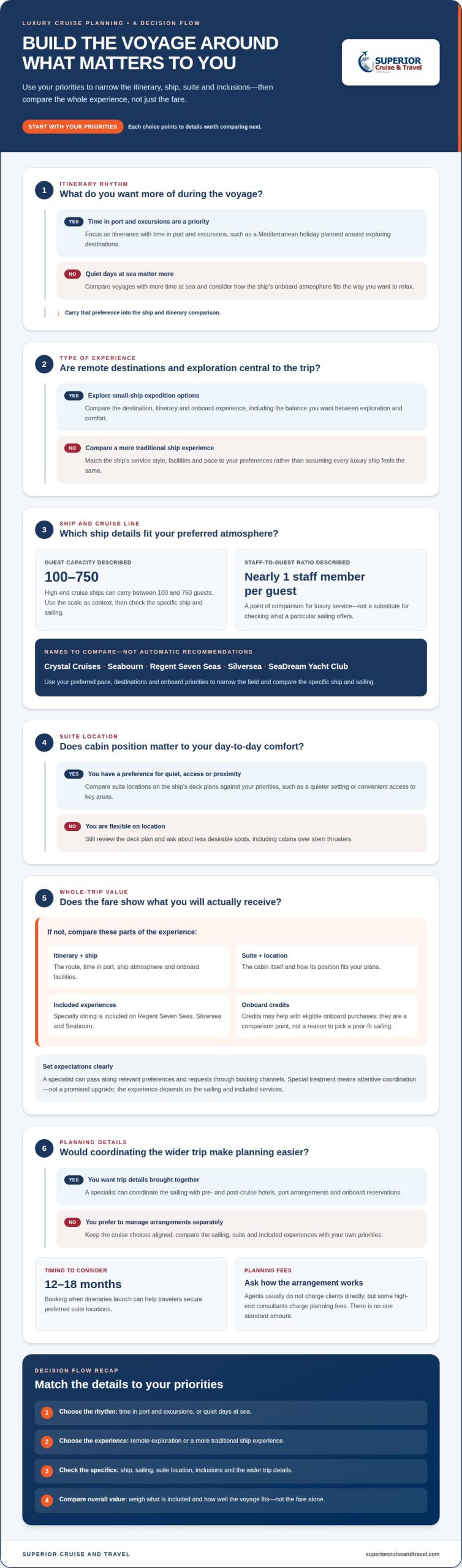
A luxury cruise consultant can connect your preferences with practical choices, from the sailing to the onboard experience. For example, a traveler planning a Mediterranean holiday may value time in port and excursions, while another may prioritize quiet days at sea. Sharing those priorities helps focus recommendations on what matters to you.
There’s an important difference between a cruise’s fare and its overall value. The ship, suite, itinerary, and included experiences all shape what you receive. On ultra-luxury lines such as Regent Seven Seas, Silversea, and Seabourn, specialty dining is included. Compare what each sailing offers, rather than judging options by the fare alone.
Onboard credits are another potential benefit. A specialist’s cruise-line contacts can help secure onboard credits and cabins, giving you more options to consider during booking. Credits can be useful for eligible onboard purchases, while the value of a cabin depends on its location and fit for your travel plans. These benefits support an informed decision, not a reason to choose a sailing that otherwise misses the mark.
Special treatment is best understood as attentive coordination, not a promised upgrade. A specialist can pass along relevant preferences and requests through the appropriate booking channels, such as noting a celebration or discussing dining preferences. This gives the cruise line useful context. The experience still depends on the sailing and the services included.
Does booking through a cruise consultant cost more than booking directly? Luxury cruise travel agents usually don’t charge clients directly, so using one doesn’t automatically mean paying a separate planning fee. Some high-end consultants do charge fees, however, so the overall arrangement can vary.
Do luxury cruise consultants charge fees, and how much? Some high-end consultants charge planning fees, while agents usually don’t charge clients directly. There isn’t one standard amount; any fee depends on the consultant’s approach and the scope of planning involved.
For a useful first conversation, share your preferred destinations, past cruise experience, and priorities for your next trip. A Mediterranean itinerary, for instance, may call for a different balance of excursions, onboard time, and dining than a voyage focused on relaxing at sea. Those details help a specialist tailor recommendations to your preferences.
The strongest benefit is having an informed guide connect individual choices to the full holiday. A specialist can explain how cabins, credits, and included specialty dining affect the experience, then help you weigh those details against your priorities. That perspective makes it easier to decide which options deserve closer attention for your upcoming travel.
Cruise-line, ship, itinerary, and suite recommendations
Choosing a cruise line is only the first decision; the ship and itinerary shape the experience that follows. A specialist can compare cruise lines, ships, itineraries, and suites against your priorities, such as a quieter onboard atmosphere or more time in port. For luxury travel, this matching process helps distinguish an exclusive-feeling voyage from one that simply has a premium label.
Names worth understanding include Crystal Cruises, Seabourn, Regent Seven Seas, Silversea, and SeaDream Yacht Club. Each is an option to consider, not an automatic recommendation. A specialist can use your preferred pace, destinations, and onboard priorities to narrow the field. If Silversea is on your shortlist, compare the specific ship and sailing with your needs.
Ship scale is another useful comparison. High-end cruise ships can carry between 100 and 750 guests, and luxury cruise staff-to-guest ratios are described as nearly one staff member per guest. Those figures help frame the experience, but they don’t replace checking what a particular sailing offers. A specialist can discuss service style and onboard facilities alongside the ship’s size.
Small-ship expedition cruises call for a different kind of matching. An advisor considers the destination, itinerary, onboard experience, and the balance you want between exploration and comfort. A traveler drawn to remote destinations may prioritize the expedition itself, while another may prefer a more traditional ship experience. These preferences help guide the choice without assuming every small ship offers the same experience.
Suite selection also benefits from detailed ship knowledge. Advisors can use deck plans to identify cabin locations that may suit your preferences and flag less desirable spots, such as cabins over stern thrusters. Compare location with your priorities: proximity to key areas, a quieter setting, or convenient access around the ship. A suite’s position can influence how the voyage feels day to day.
Itinerary recommendations should reflect more than a destination name. A global route, a series of shorter port calls, and a voyage with extended time at sea offer different rhythms. Share which experiences matter most, then let a specialist connect those preferences to suitable ships and itineraries. This helps focus your choice on the details that will shape the trip.
For tailored guidance on cruise options, explore luxury cruise planning as you consider your upcoming voyage.
Booking and trip-detail management
Booking a luxury voyage involves more than reserving a suite. A specialist can coordinate the sailing with the surrounding vacation, including pre- and post-cruise hotels, port arrangements, and onboard reservations. Bringing these details together helps create a clearer travel plan, especially when a cruise is one part of a longer holiday.
Timing can affect which options are available. Booking a luxury cruise 12 to 18 months in advance, when itineraries launch, can help travelers secure preferred suite locations and early-booking incentives. For upcoming travel, this lead time also gives the specialist a wider planning window for connecting arrangements. Wave Season for luxury cruise booking runs from January through March, another period to consider when reviewing future plans.
Once you choose a sailing, a cruise advisor can help organize booking details that are easy to overlook. These may include dining reservations, spa appointments, payment dates, and booking windows for excursions and restaurants. Organizing the dates around the voyage helps keep each reservation connected to your vacation plan.
Port days need their own coordination. A specialist can help arrange private drivers and guides at ports of call, along with hotels before or after the cruise. For example, a traveler hoping to explore local culture or wildlife can discuss those interests with the advisor, who can help shape port plans around the itinerary and available excursions.
Good trip planning connects each element in the right order. An advisor can align the hotel stay with the cruise schedule, organize port plans around the ship’s calls, and track relevant booking windows. If a spa appointment or excursion matters to you, identifying it early helps coordinate the timing with other reservations.
- Before booking: Share preferred travel dates, destinations, suite priorities, and any pre- or post-cruise hotel plans.
- During planning: The advisor coordinates dining, spa appointments, excursions, payment dates, and port arrangements.
- As the voyage approaches: Review the organized itinerary and upcoming reservation windows with your advisor.
That structure is especially helpful for a grand voyage or a trip with several connected stays. Rather than treating each reservation as a separate decision, a specialist can map the vacation as a sequence, from hotel arrival to port visits and the final day onboard. This joined-up approach makes it easier to see how each detail fits.
For a wildlife-focused itinerary, for instance, an advisor can consider the cruise’s ports and excursions alongside your preferred pace. For a city-centered voyage, hotel placement and guided port visits may matter more. Sharing these priorities early gives the planning process direction and helps keep the trip’s details coordinated.
Client advocacy when problems arise
A travel disruption can affect several parts of a cruise at once. If a port call changes during a Caribbean voyage, for example, a consultant can help you understand the update, communicate with the cruise line, and consider how it affects your plans. Their role is to clarify next steps and help organize decisions, not to promise a particular outcome.
Start by sharing the issue and the details tied to your booking. A cabin concern, a changed itinerary, or a reservation that doesn’t match your expectations each calls for a different conversation. A consultant can help present the relevant information clearly and relay the cruise line’s response, so you can understand the options and decide what works for you.
For an itinerary change in Europe, the practical effects may extend beyond the ship. A traveler with a planned guided visit or hotel stay connected to a port day may need to review those arrangements. A consultant can help identify which cruise plans are affected and coordinate communication about them, giving you a clearer view of what needs attention next.
Clear communication matters. A useful process is to:
- Describe the issue: Explain what changed, such as a revised port call or a cabin concern.
- Share the relevant booking details: Provide the sailing and reservation information the cruise line needs to locate the matter.
- Review the response: Discuss the available options with the consultant before deciding on a next step.
That structure is helpful during a custom trip, where one change can affect several plans. If a port visit in America shifts, for instance, a consultant can help separate the cruise update from arrangements you made independently. This makes it easier to focus on the issue the cruise line can address and identify which decisions remain yours.
Support can also help when expectations and confirmed details differ. If you understood a dining or cabin arrangement differently, a consultant can help frame the question and follow the discussion with the cruise line. A clear account of what was booked and what you expected gives the conversation a practical starting point.
For an unforgettable holiday, advocacy means having an informed person help organize questions and responses, especially when travel plans change. A consultant can keep the conversation focused on the affected sailing, explain the information received, and help you consider the next step. That guidance can be useful before departure or during the voyage.
Cruise-advisor expertise and client matching
The right advisor connects your travel preferences with relevant cruise knowledge. A strong match considers destinations, ship amenities, and how you want your voyage to feel.
Questions Before Hiring
What questions should I ask before hiring a cruise consultant? Ask about experience with your preferred destinations, knowledge of cruise lines, and how ship amenities are matched to your priorities. Also ask how recommendations are developed and what planning support covers.
Use a specific example to understand the advisor’s approach. If you’re considering a world voyage, ask how they would weigh the route, time at sea, and onboard experience. Their explanation should connect those choices to your preferences, rather than relying on a general description of luxury travel.
What are the risks of using a cruise consultant, and how can I verify credentials? A mismatch can lead to recommendations that don’t suit your preferred pace, destinations, or amenities, so look for relevant cruise experience and clear explanations. CLIA certification is one credential to look for, and CLIA and ASTA provide resources for finding travel agents.
Agency and Cruise-Line Affiliations
Are luxury cruise consultants affiliated with travel agencies or cruise lines? Consultants may work through a travel agency and build relationships with cruise-line partners, but they aren’t necessarily employed by a cruise line. Ask how agency and partner relationships shape the options presented and whether recommendations reflect your priorities.
An advisor’s network can help with access to cruise information and booking channels. Still, affiliation alone doesn’t establish a good personal fit. Ask how the advisor compares destinations, itineraries, and amenities across recommended options, and how they explain the trade-offs.
Experience is most useful when it aligns with your travel style. Someone familiar with European port itineraries may suit a traveler seeking historic cities, while a guest focused on onboard relaxation may prioritize different ship amenities. The key is relevant knowledge, not a broad claim of expertise.
Listen for specific reasoning. An advisor should be able to explain why a route fits your available time or how a ship’s atmosphere relates to your preferences. For a custom trip, details such as preferred excursions, dining style, and days at sea help shape a more personal recommendation.
An advisor’s partners can also influence what they know well, so ask how they stay familiar with current cruise options. A clear answer should connect their experience to your plans, whether you’re considering a single destination or a longer voyage. That conversation helps you judge whether their expertise fits your needs.
Share your priorities and past travel experiences, then notice whether the advisor uses them to refine recommendations. For help matching your preferences with cruise options, plan your next cruise.
Superior Cruise and Travel: Luxury Cruises
Superior Cruise and Travel helps travelers turn their preferences into a considered luxury cruise plan. If you’re weighing ship, itinerary, and suite options for an upcoming voyage, the agency’s luxury cruise planning is a natural next step.
Its wider portfolio also includes chartered cruise ships, world cruises, and resort vacations. That range can suit plans for a private ship experience, an extended voyage, or time at a resort. Share the destinations and experiences you have in mind, along with the details that matter most, to start shaping a trip around your priorities.
Contact Superior Cruise and Travel to discuss your next luxury cruise.
Shape the next voyage around what matters most
Your next cruise begins with a clear sense of what you want from the journey. Before planning, consider the atmosphere you enjoy, the destinations that interest you, and how much of the experience you’d like arranged in advance. Those priorities give a luxury cruise consultant a practical starting point for recommendations tailored to your travel.
It’s also worth thinking beyond a single sailing. Your plans may grow into a longer voyage or a different kind of escape later, and a trusted planning relationship can make those decisions easier to approach. Start with the trip you’re considering now, then let your preferences guide the conversation.
When you’re ready to discuss your upcoming plans, contact Superior Cruise and Travel. Bring the ideas you’re considering, and take the next step toward a journey that feels distinctly yours.
Frequently Asked Questions
What are the main factors that determine luxury cruise prices?
Luxury cruise prices depend on the sailing, suite category, itinerary, and what the fare includes. A voyage with more included experiences may compare differently from one where travelers arrange more services separately. For a useful comparison, consider the whole trip, including any hotel stays or port activities, rather than judging options by the cabin fare alone. Your preferred travel dates and suite location also shape the available choices.
Which cruise lines are priced higher and represent ultra-luxury?
Regent Seven Seas, Silversea, and Seabourn are recognized as ultra-luxury cruise lines, and specialty dining is included on these lines. That doesn’t establish a fixed price ranking across every sailing. The itinerary, ship, suite, and inclusions all affect the fare. Compare specific voyages based on what each offers, then consider whether those features match your priorities and the experience you want.
Which luxury cruise lines offer the best value or most affordable entry points?
There isn’t one luxury cruise line with the most affordable entry point for every traveler. Value depends on the specific sailing, suite category, itinerary, and inclusions. Compare options from lines such as Crystal Cruises, Seabourn, Regent Seven Seas, Silversea, and SeaDream Yacht Club by looking at the full experience, not just the starting fare. A different suite or itinerary may better suit your priorities.
What does a luxury cruise consultant do?
A luxury cruise consultant helps turn your travel preferences into a coherent cruise plan. For example, if you’re combining a sailing with a resort stay, the consultant can help coordinate both parts of your vacation. They can also help interpret booking details and organize relevant arrangements, giving you a clear point of contact for planning decisions and questions as your upcoming trip takes shape.
What luxury cruise lines and itineraries do cruise advisors specialize in?
Advisors may specialize in different lines and itinerary styles, so the best fit depends on your destination and preferences. Relevant experience could include a world cruise, a Mediterranean voyage, or an expedition-focused sailing. Share the places you hope to visit and the pace you prefer. This helps establish whether an advisor’s knowledge aligns with your plans and the onboard experience you’re seeking.
How do cruise advisors compare cruise lines, ships, and cabin options?
Advisors compare details that distinguish one sailing from another, including ship layout, suite location, itinerary, and onboard experience. A practical comparison might weigh a preferred departure port against a more suitable suite or route. They can also explain how cabin placement relates to your preferences. The aim is to make trade-offs clear, so you can choose the combination that best suits your trip.
What perks and amenities can a cruise advisor secure?
A cruise advisor may help secure onboard credits and cabins through cruise-line contacts, although specific perks depend on the booking. Specialty dining is included on Regent Seven Seas, Silversea, and Seabourn. Ask how any benefit applies to the sailing you’re considering and distinguish confirmed booking details from a request. That makes it easier to assess amenities as part of the trip’s overall value.
How does a luxury cruise consultant manage the booking process?
A luxury cruise consultant can organize the booking from cruise selection through reservation details and connected travel arrangements. The process may include coordinating a resort stay with a cruise, tracking payment dates, and helping manage dining or excursion reservations. You provide your preferences and key trip details; the consultant brings the moving parts together and explains which decisions need your attention next.