
An all-inclusive resort isn’t automatically the right fit for every trip. For resort vacations, the best choice depends on what you want from your stay and what the package actually covers. If listings use similar labels but describe inclusions differently, compare the details rather than relying on the headline offer.
Meals, drinks, activities, transportation, and other features can be handled differently from one package to another. A less bundled option may suit travelers who want flexibility, while a package with more included components may simplify planning. Neither is better for everyone: value depends on what you plan to use and what you would otherwise need to arrange.
This guide explains how to compare resort stay styles, check package terms, and weigh practical trade-offs against your priorities. Use the planning checklist to clarify exclusions, cancellation conditions, and any travel components that need separate coordination. A clear list of must-haves and open questions makes it easier to compare suitable options and decide what to arrange next.
Key Takeaways
- Choose a resort stay based on your trip’s purpose, preferred pace, and traveler needs, not just the “resort” label.
- Compare room-only, meal-plan, and all-inclusive options by checking the written terms for package-dependent inclusions and exclusions.
- Use a pre-booking checklist to confirm dates, accessibility needs, cancellation terms, and what’s required to complete your itinerary.
- Account for how flights, ground transportation, lodging, and planned activities fit together when comparing resort vacations.
- If your trip includes multiple travel components, consider planning support from Superior Cruise and Travel to help coordinate the details.
What Are Resort Vacations, and Which Stay Styles Can You Choose?
A resort vacation is a trip built around accommodation at a property with leisure amenities on-site or nearby. Those amenities might include dining, recreation, or activities, but what’s available and included depends on the property and booking terms. “Resort” describes a type of destination or accommodation, not a promise that meals, entertainment, or transportation come with the stay. The broad definition of a Resort can help explain the term, but the specific property and package determine what your stay offers.
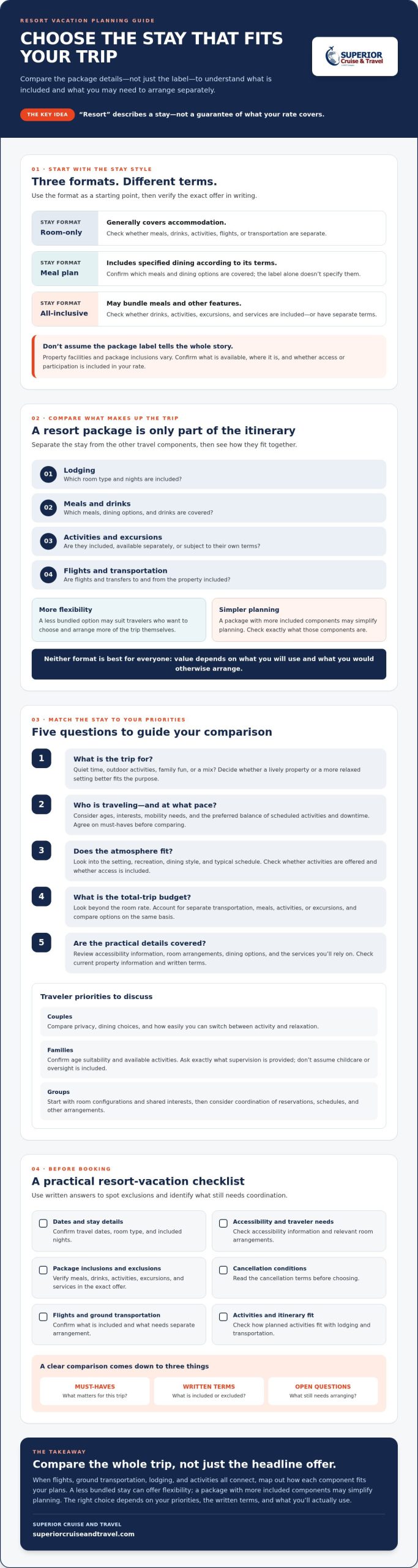
Resort vacations can be booked in different formats. A room-only rate generally covers accommodation, while a meal plan includes specified dining according to its terms. An all-inclusive arrangement may bundle meals and other features, but the name alone doesn’t tell you which drinks, activities, or services are covered. Treat each format as a starting point for comparison, then check the terms for the exact offer.
What makes a resort vacation different from a hotel stay?
A resort stay often puts leisure amenities or recreation at the center of the experience, with dining and activities available on-site or nearby. A conventional hotel may primarily serve as a place to sleep while you explore elsewhere. The distinction isn’t absolute: properties use these labels differently, and facilities vary. Check what’s available, where it is, and whether access or participation is included in your rate.
What do resort packages usually include?
Start by separating accommodation from the other parts of your trip. A package may cover lodging alone or combine it with selected meals, flights, transfers, activities, or excursions. The specific offer determines what’s included, and some components may need to be arranged separately.
Before choosing, look for written answers to questions such as:
- Which room type and nights are included?
- Are meals included? If so, which meals and dining options?
- Are drinks, activities, or excursions part of the package, or do they have separate terms?
- Are flights and transportation to and from the property included?
Read the package terms instead of relying on labels or promotional summaries. “Meal plan” doesn’t specify the number or type of meals, and “all-inclusive” doesn’t necessarily mean every activity, excursion, or service is covered. Confirm the inclusions, exclusions, and conditions for the exact offer before booking. This gives you a reliable basis for comparing stays and identifying what remains to be arranged.
How to Choose a Resort Vacation That Fits Your Travel Priorities
Start with what you want the trip to feel like, then use that priority to narrow your options. The right resort depends on your priorities and the package details, not simply on a property’s label or list of amenities. These steps can help you focus your search.
- 1. Define the trip’s purpose. Decide whether you’re looking for quiet time, outdoor activities, family fun, or a mix. That purpose can help you judge whether a lively property or a more relaxed setting is a better fit.
- 2. Consider who’s traveling and at what pace. Account for everyone’s ages, interests, mobility needs, and preferred balance of scheduled activities and downtime. Discuss must-haves before comparing properties.
- 3. Compare atmosphere and activity level. Look into the property’s setting, recreation, dining style, and typical schedule. If you want peaceful mornings, a packed activity calendar may not appeal. If you prefer variety, check what’s offered and whether access is included.
- 4. Set a total-trip budget. Consider the full itinerary, not just the room rate. Include package features and any separate costs for transportation, meals, activities, or excursions. Compare options on the same basis so you can see which one fits your plans.
- 5. Check the practical details. Review accessibility information, room arrangements, dining options, and any services you’ll rely on. Confirm details against current property information and the written package terms.
How should couples, families, and groups prioritize resort features?
Couples may want to compare privacy, dining choices, and how easily they can alternate between activity and relaxation. Families should confirm age suitability and available activities, and ask exactly what supervision is provided rather than assuming childcare or oversight is included. Groups can start with room configurations and shared interests, then consider how reservations, schedules, and other arrangements will be coordinated.
Make a short list of non-negotiables for your travel party. This keeps appealing extras from distracting you from needs such as accessible facilities, suitable sleeping arrangements, or a quieter atmosphere.
Which destination and season factors should shape your shortlist?
Match the destination to the climate you prefer, the time you’re willing to spend traveling, and the activities you hope to enjoy. Then check seasonal conditions and property operating schedules using current, reliable sources. Conditions or seasonal closures can affect the experience, so confirm what applies to your dates. Examples can provide inspiration, but they don’t confirm that a particular package or facility will be available.
If your shortlist involves coordinating a resort stay with flights or other trip components, resort vacation planning support may help bring the arrangements together. Superior Cruise and Travel coordinates multi-component travel. Confirm the services and terms that apply to your trip.
How to Compare Resort Vacation Packages and Avoid Assumptions
Compare the written details, not just the package name. Use the table as a starting point: every item is package-dependent, and the exact terms determine what’s covered.
| What to compare | Room-only | Meal plan | All-inclusive |
|---|---|---|---|
| Accommodation | Package-dependent; verify room type and nights. | Package-dependent; verify room type and nights. | Package-dependent; verify room type and nights. |
| Meals | Package-dependent; often arranged separately. | Package-dependent; check which meals and dining venues apply. | Package-dependent; confirm meal coverage and any limits. |
| Drinks | Package-dependent; check whether any are included. | Package-dependent; verify included drinks and conditions. | Package-dependent; confirm covered drink options and exclusions. |
| Transfers | Package-dependent; verify whether transportation is included. | Package-dependent; verify whether transportation is included. | Package-dependent; verify whether transportation is included. |
| Activities and excursions | Package-dependent; check access and separate charges. | Package-dependent; check access and separate charges. | Package-dependent; confirm which activities are covered. Excursions may be extra. |
| Resort fees and taxes | Package-dependent; check what may be charged separately. | Package-dependent; check what may be charged separately. | Package-dependent; check what may be charged separately. |
What should you check in the package terms?
Before booking, confirm which meals, drinks, transfers, resort fees, activities, and applicable taxes are covered by your offer. Review cancellation and change conditions, payment timing, and occupancy rules, including any room or traveler requirements. Look for exclusions and optional charges in the detailed terms, not only in a short description. If something is unclear, ask for clarification in writing so you can compare the same details across options.
An all-inclusive label doesn’t automatically cover every excursion, premium service, or transfer. A package may bundle selected features and leave others outside the offer. The option with the longest list of inclusions isn’t automatically the best fit, either. If you plan to explore beyond the property, for example, you may value flexibility over bundled on-site activities. Compare what you’re likely to use with what you’ll still need to arrange.
When does an all-inclusive resort vacation make sense?
An all-inclusive stay may suit travelers who prefer predictable on-site dining and activities, especially if they expect to spend much of the trip at the property. If independent dining and off-property exploration are central to your plans, compare the package with a less inclusive format and account for those separate arrangements. For a closer look at how these stays work, see the all-inclusive resorts guide. Clear terms make resort vacations easier to compare for value and fit.
What to Plan Before Booking a Resort Vacation
A smooth stay depends on more than choosing a property. Before booking, check that the dates, traveler needs, package terms, and journey to and from the resort work together. Use this checklist to catch details that could affect the full itinerary:
- Travel dates: Confirm arrival and departure dates, then check the resort’s availability and any relevant seasonal operating schedules.
- Traveler needs: Verify room arrangements, accessibility details, age requirements, and other needs that affect your party.
- Package terms: Review what’s included, what costs extra, and the conditions for changes or cancellation.
- Destination guidance: Check current entry, health, and destination information through official government sources for your destination and citizenship.
- Trip components: Map out flights or other transport, transfers, lodging dates, and activities so the timing works as a whole.
A resort booking may cover only part of the trip. A flight arrival time, transfer schedule, or planned excursion can affect when you need to leave and how much flexibility you have. Build the itinerary around confirmed arrangements, and leave appropriate time between connections instead of assuming each provider’s schedule will line up automatically.
How can you coordinate the parts of a multi-component trip?
List every component that needs to align: transportation to the destination, resort check-in and check-out dates, transfers, and planned activities or excursions. Confirm schedules and meeting points with the relevant providers, and allow enough time for connections and unexpected delays. If planning several components feels complex, the article why travelers use a professional travel agent offers more context. Superior Cruise and Travel can be considered for eligible multi-component travel arrangements.
What should you know about travel protection?
Travel protection options aren’t the same as insurance underwriting, and terms vary by plan and trip. Availability isn’t automatic; options depend on eligible trip components and specific terms. Before deciding, review the benefits, exclusions, eligibility requirements, and claim procedures in writing. Ask which parts of your itinerary qualify and what circumstances the terms address. Don’t assume a resort booking or a single travel component is covered.
For help coordinating a resort stay with other eligible trip components, request support with your travel plans. Confirmed schedules and terms can make resort vacations easier to prepare for and enjoy.
Plan Your Resort Vacation With a Clear, Supported Next Step
You’ve considered what matters in a stay and how to read package terms. Turn those preferences into a practical plan: define your priorities, compare the written details, confirm how the travel components fit together, and decide whether you need planning support.
Preparation can make the next conversation more useful. Note what’s essential, where you have flexibility, and which details still need answers. This gives you a clear way to assess suitable resort vacation options without assuming every property or package offers the same experience.
When can a travel advisor help with resort vacation planning?
Planning support may be helpful when your resort stay is one part of a larger trip involving flights and ground transportation. Each component has its own terms and schedule, so coordinating the overall itinerary can help you see how the pieces fit before you commit. For a group trip, it can also help to identify shared needs, room arrangements, and planning considerations early.
Superior Cruise and Travel offers resort vacations and coordinates eligible multi-component travel. Its global supplier network supports leisure vacations and resort packages, and the agency is BBB-accredited. These details provide context as you consider planning support, but they don’t guarantee a particular resort, availability, rate, or outcome. The agency does not offer single-component travel, so its planning support is relevant when a trip includes eligible travel components beyond one component.
What information should you prepare before asking for help?
Start with the basics, even if some details are still flexible. Share your preferred travel dates, number of travelers, and the purpose of the trip, such as relaxation, family time, or a group gathering. Then describe your must-have features, preferred pace, accessibility needs, and any room or dining considerations that could shape the shortlist.
It’s also useful to identify what you’re open to changing. Flexible dates, destinations, or activity preferences may affect which options are worth exploring, while clear non-negotiables help keep the search focused. Bring questions about package terms, transportation, or how the itinerary could fit together. Confirm availability and terms for the options being considered.
With your priorities and key details in hand, you can take the next step at a comfortable pace. Start planning your resort vacation by sharing what you want from the trip and exploring options that fit.
Take the Next Step Toward a Resort Stay That Fits
The right choice comes down to your priorities, not the package label. Decide what matters most, compare written inclusions and exclusions, and confirm how transportation, lodging, and activities fit together. These checks can make resort vacations easier to plan with confidence.
If your plans include multiple travel components, Superior Cruise and Travel may be able to help coordinate the details. The BBB-accredited full-service travel agency draws on a global supplier network for leisure vacation planning. Travel protection options may be available for eligible multi-component trips, subject to specific terms, so review the details rather than assuming protection is included.
Bring your preferred dates, traveler needs, and must-have features to start a conversation about options that suit your plans. Talk with Superior Cruise and Travel about planning your resort vacation. With your priorities clear and the details checked, you can look forward to a stay that fits the way you want to travel.
Frequently Asked Questions
What is a resort vacation?
A resort vacation is a trip centered on a stay at a property with leisure amenities on-site or nearby. Depending on the property, these might include dining, recreation, or organized activities. Resort vacations vary widely, so the label doesn’t confirm which amenities are available or included in your rate. Check the property details and booking terms to understand what the stay offers and what you may need to arrange separately.
Are resort vacations always all-inclusive?
No. A resort stay may be room-only, include a meal plan, or offer an all-inclusive arrangement. Those formats aren’t interchangeable, and even “all-inclusive” doesn’t necessarily mean every drink, activity, excursion, premium service, or transfer is covered. Read the specific package terms to see what’s included, what has limits, and what costs extra. This helps you compare options based on the experience you want rather than the package label alone.
What is usually included in a resort vacation package?
Inclusions depend on the particular offer. A package may cover lodging alone or combine it with selected meals, drinks, flights, transfers, activities, or excursions. Don’t assume an item is included because it appears in a description or because the package has an all-inclusive label. Check the written terms for room details, covered services, exclusions, extra charges, and applicable conditions. Confirm cancellation and change rules before booking, too.
How do I choose the right resort vacation for my family?
Start with your family’s ages, interests, accessibility needs, and preferred pace, then shortlist properties that fit those priorities. Check whether activities suit your children’s ages and ask what supervision arrangements, if any, are provided. Review sleeping arrangements, dining options, and the distance between accommodations and the amenities your family expects to use. Confirm details with the property and compare package terms so you know which activities or services require separate arrangements.
Are resort vacation packages worth it?
A package may be a good fit if its included components match what you plan to use and its terms work for your trip. Compare the full itinerary, including lodging, transportation, meals, activities, and anything not covered, rather than judging by the number of inclusions. If you expect to dine independently or spend much of your stay exploring elsewhere, a less bundled arrangement may suit you better. The best choice depends on your plans and preferences.
What should I check before booking a resort vacation?
Confirm travel dates, room arrangements, traveler needs, package inclusions and exclusions, and cancellation or change terms. Check how flights or other transport, ground transfers, resort dates, and planned activities fit together. Review current entry, health, and destination guidance through official sources relevant to your trip. If considering travel protection for an eligible multi-component itinerary, read the specific benefits, exclusions, eligibility rules, and claim procedures in writing. Don’t assume protection is automatic.
Can a travel agent help plan a resort vacation package?
A travel agent may help coordinate a resort trip that combines eligible travel components, such as lodging and transportation, and clarify how arrangements fit into the overall itinerary. Superior Cruise and Travel is a BBB-accredited full-service travel agency with a global supplier network for leisure vacation planning. It offers travel protection options for eligible multi-component experiences, subject to specific terms. The agency does not offer single-component travel or underwrite travel insurance.