
The right destination wedding travel coordinator may not be the person who plans your wedding day. Their value often lies in a different, equally important role: making guest travel and accommodation easier to manage while your wedding planner focuses on the celebration itself.
If you’re unsure who handles room arrangements, answers travel questions, or steps in when plans change, you’re not alone. These responsibilities can overlap, and a resort’s on-site coordinator may have a different scope. Agreeing on roles before you commit can prevent confusion later.
This guide explains what a destination wedding travel coordinator may handle, how the role differs from a wedding planner and resort coordinator, and what to ask when comparing candidates. You’ll also learn how to assess group-travel experience, clarify fees and included services, and ensure the professionals on your team know how they’ll work together. With clear boundaries in place, you can choose support that suits your celebration and gives you a more reliable way to coordinate guest travel.
Key Takeaways
- Clarify where travel logistics end and wedding-day planning begins so each professional’s responsibilities complement one another.
- Compare providers by their confirmed services, not assumptions. Inclusions can vary between travel professionals, planners, and resorts.
- Ask a destination wedding travel coordinator for specific examples of group experience, communication practices, and how changes are handled.
- Match the support you need to your guests’ booking preferences and travel arrangements, as well as the time you can personally devote.
- Before sharing plans with guests, confirm the provider’s scope in writing and verify destination-specific details with the relevant suppliers.
What Does a Destination Wedding Travel Coordinator Actually Handle?
A destination wedding travel coordinator focuses on travel arrangements connected to the celebration, not every decision involved in planning the wedding. In short, this professional may coordinate how the couple and guests get to and stay at the destination. Ceremony design, reception details, and wedding-day execution usually belong to a planner or venue team unless a separate agreement specifically includes them.
The exact scope varies. A travel agent may help arrange travel through a supplier network, as described in this overview of what is a travel agent, but the title alone doesn’t confirm which tasks a particular provider accepts. Treat a service as confirmed only when the provider has agreed to it. Consider unconfirmed tasks potential support, and assume event-planning duties are excluded unless the agreement says otherwise.
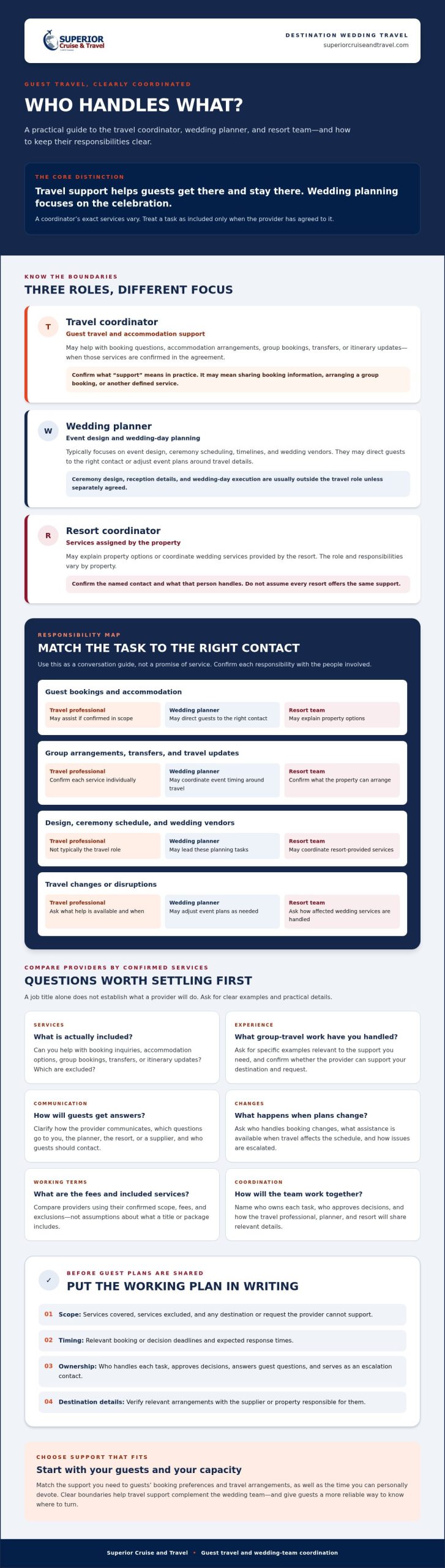
Travel coordinator, wedding planner, or resort coordinator?
A travel professional may help with guest booking questions, accommodation arrangements, or travel details. Whether they can manage group bookings, room arrangements, transfers, or itinerary updates depends on their capabilities and agreement. Ask what they will do in practice. For example, “support with accommodation” could mean sharing booking information, arranging a group booking, or something else entirely.
A wedding planner typically focuses on event design, ceremony scheduling, timelines, and wedding vendors. A resort coordinator works within the responsibilities assigned by the property and may oversee wedding services offered there. Resort duties vary, so confirm the named contact and what that person handles. To prevent duplicated work or gaps, make a responsibility list showing who owns each task, who approves decisions, and who guests should contact.
Which travel tasks should be clarified before hiring?
Start with the questions your guests are likely to ask. Can the provider help with booking inquiries or accommodation options? Is group booking support, transfer coordination, or itinerary updating available? Who handles requests to change a booking, and what happens if a travel issue affects the schedule? Confirm how the provider communicates with guests and which questions should go to you, the planner, the resort, or the supplier instead.
Then put the working boundaries in writing. Include services covered and excluded, relevant booking or decision deadlines, expected response times, and escalation contacts. If the provider can’t support a destination or request, find that out before relying on them. This clarity helps travel support complement your wedding team and gives guests a clear place to turn.
How to Compare Destination Wedding Travel Coordinator Services
Compare the work each provider will take responsibility for, not just their title. A travel professional may support guest arrangements, but the exact services depend on the provider and written agreement. Wedding planners focus on the event, while resort staff work within the responsibilities assigned by their property. For a useful overview of what a destination wedding planner does, consider how that role differs from travel support.
| Responsibility | Travel professional | Wedding planner | Resort team |
|---|---|---|---|
| Guest bookings and accommodation | May assist if confirmed in scope | May direct guests to the right contact | May explain options offered by the property |
| Group arrangements, transfers, and travel updates | Confirm each service individually | May coordinate event timing around travel details | Confirm what the property can arrange |
| Design, ceremony schedule, and wedding vendors | Not typically the travel role | May lead these planning tasks | May coordinate services provided by the resort |
| Travel changes or disruptions | Ask what assistance is available and when | May adjust event plans as needed | Ask how the property handles affected wedding services |
Use the table as a starting point, not a promise of service. Resort responsibilities differ, and familiarity with a destination doesn’t automatically mean a provider can manage every travel component. If your celebration is at an all-inclusive property, an all-inclusive resort planning guide can help you prepare questions about the stay and resort arrangements.
What belongs in a written scope of services?
Ask the provider to state whether guest booking questions, accommodation coordination, travel updates, and transfers are included, excluded, or handled by someone else. Clarify who contacts suppliers, manages booking changes, and responds to time-sensitive guest questions. If your plans combine a resort stay with other travel components, confirm how those arrangements affect the provider’s responsibilities and ask whether any travel protection options apply to the proposed trip.
How can you assess experience and communication fit?
Ask for examples of relevant group travel, then discuss what is comparable to your plans without assuming the provider has wedding-specific experience. Agree on communication channels, expected response times, and backup contacts before signing. A good fit explains limitations clearly and is willing to coordinate responsibilities with your wedding planner. If you’re considering travel support, you can review group travel and resort planning with Superior Cruise and Travel and confirm whether the requested scope is supported.
Questions to Ask Before Hiring a Destination Wedding Travel Coordinator
A reassuring conversation is a good start, but broad promises won’t tell you who will answer a guest’s question or handle a booking change. Ask for clear examples, then compare the answers with your itinerary and needs. The written scope, not the job title, defines what service you’ll receive.
Use this interview checklist to see whether the provider’s experience, communication style, and boundaries fit your plans.
Questions about guests, bookings, and group logistics
- What guest support is included? Ask whether you can direct guests to the provider for booking questions, deadlines, and travel updates. Confirm which individual traveler requests fall outside the scope.
- How are changes handled? Ask for a specific example, such as a guest needing to change travel details. Clarify who contacts the supplier, what the provider can do, and what remains the traveler’s responsibility.
- Who coordinates with the wedding team? Find out how information is shared with you, the resort, and your wedding planner, and who is responsible for keeping details aligned.
- What group experience is relevant? Request an example of a group trip with similar booking or accommodation needs. Ask what the provider personally managed rather than relying on general claims of expertise.
These questions help establish whether the destination wedding travel coordinator can support your specific arrangements. A confident “yes” matters less than a clear explanation of the process and its limits.
Questions about contingencies and accountability
- Who should guests contact if an issue arises outside normal planning hours? Ask what contact options exist, who monitors them, and what guests should do if the provider isn’t available.
- How are disruptions escalated? Discuss examples such as a missed connection or a supplier change. Confirm who communicates updates and who makes decisions that could affect wedding plans.
- What terms will be documented? Request written confirmation of fees, cancellation terms, responsibilities, response expectations, and escalation contacts.
- Are travel protection options relevant? If the proposed itinerary includes multiple travel components, ask what options may apply and request an explanation of their terms. Don’t assume the provider underwrites coverage or that every booking is eligible.
Support is useful only when responsibilities and limitations are explicit. Before signing, check that the agreement reflects the answers you received. If an important task has no named owner, clarify it with the provider and wedding team first.
Match Travel Coordination to Your Wedding Group’s Needs
The right level of travel support depends on more than the number of guests. Consider how independently they’ll book, how many arrangements need to fit together, and how much time you can spend answering questions or sharing updates. A destination wedding travel coordinator may help when logistics are taking time away from the celebration, but first confirm that the provider can support your group and destination.
Think through your likely scenarios:
- Guests are booking independently. Separate reservations and varied arrival plans can lead to more questions and updates. Ask whether the provider answers individual traveler inquiries or only coordinates group-level arrangements.
- Guests need guidance. If people may be unfamiliar with the destination or booking process, clarify what information the provider can share and whether guests can contact them directly.
- Your itinerary has several moving parts. If travel involves flights, accommodation, transfers, or a cruise, confirm which components the provider can arrange and how a change to one may affect the others.
- You have limited time to manage details. Identify the tasks you want to hand off, then check that the provider’s written scope covers them. If you’re comfortable managing guest questions and updates, you may need less support.
When guests book independently or need extra guidance
Independent booking can give guests flexibility, but it may leave you piecing together different arrival times and reservation details. Agree on one shared source for approved information, such as a wedding website or a clearly maintained itinerary. Confirm who updates it, how guests can ask questions, and who verifies details before they’re shared. This helps prevent conflicting instructions without assuming a coordinator will manage every individual booking.
When a resort stay includes multiple travel components
List each arrangement you’re considering, then ask the provider which ones they can support. A resort stay combined with flights, transfers, or a cruise may involve different suppliers and booking terms, so confirm how changes are handled across the itinerary. For broader context, consider the benefits of professional travel planning, while basing your decision on the provider’s actual capabilities and the destination’s arrangements.
Superior Cruise and Travel works with group travel and resort holidays, but destination-wedding coordination isn’t confirmed as a specific service. Couples can review their group travel and resort requirements with the agency and confirm whether the requested travel components fit its scope.
Your Next Steps: Choose a Coordinator and Confirm the Plan
Once you know what help your group needs, turn that list into a written plan. Evaluate a destination wedding travel coordinator by confirmed capabilities and clear terms, not just a job title or a reassuring first conversation. Use this sequence before committing:
- List your travel needs. Note the destination, approximate guest count, travel components, likely booking questions, and tasks you want someone else to handle.
- Shortlist providers. Compare documented services, relevant group-travel experience, destination familiarity, and communication fit. Ask for examples related to your arrangements.
- Compare written scopes. Mark who owns each travel and wedding task. Resolve gaps between the travel provider, resort contact, and wedding planner before anyone assumes someone else is handling them.
- Review the terms. Confirm the booking process, payment schedule, cancellation terms, responsibilities, and support contact in writing. Make sure the agreement matches what you discussed.
- Brief your wedding team. Share the final task list and approved guest information with the people responsible for communicating it.
Before sending details to guests, verify destination-specific logistics and current information with the relevant suppliers. Dates, arrangements, and contact details can change, so use one approved source for updates and identify who will keep it accurate.
A simple decision process before you commit
Choose the provider whose written scope covers the travel tasks you actually need, and make sure every remaining responsibility has an owner. If a provider can’t confirm a service, treat it as outside the scope until agreed otherwise. A clear division of work helps travel arrangements support the wedding without confusing them with ceremony or reception planning.
How to start a conversation with a travel agency
Prepare your destination, approximate guest count, timing, travel components, and the kind of support you’re seeking. Superior Cruise and Travel works with group travel and resort holidays, but destination-wedding coordination isn’t confirmed as a specific service. Ask which travel components the agency can support and which needs require another professional.
Review your group travel plans with Superior Cruise and Travel and confirm whether they fit the agency’s scope. A clear conversation can help you decide what support belongs on your wedding team.
Choose Support That Fits Your Celebration
The right destination wedding travel coordinator is defined by clear responsibilities, not an impressive title. Before deciding, match the support you need to your group’s travel arrangements, confirm which services are included, and get the boundaries in writing. That clarity helps travel support complement your wedding planner and resort team instead of leaving gaps or duplicating work.
Superior Cruise and Travel is a BBB-accredited, full-service travel agency with a global supplier network and services that include group travel and resort planning. Destination wedding coordination isn’t confirmed as a specific service, so discuss your travel requirements and verify exactly which components the agency can support before making plans.
Discuss your group travel and resort requirements with Superior Cruise and Travel to confirm whether your needs fit the agency’s scope.
Frequently Asked Questions
What does a destination wedding travel coordinator do?
A destination wedding travel coordinator focuses on travel arrangements connected to the celebration, such as organizing guest travel information and coordinating agreed accommodation or itinerary details. The exact scope depends on the provider. Don’t assume the role includes ceremony planning, décor, vendor contracts, or wedding-day management. Before hiring, request a written list of included and excluded tasks so you know who handles each responsibility.
Is a destination wedding travel coordinator the same as a wedding planner?
No. A wedding planner generally focuses on event decisions and execution, while a travel coordinator focuses on travel logistics for the couple and guests. The roles may overlap around timing and guest communication, but neither title guarantees a particular service. Ask both professionals to define their responsibilities, identify any shared tasks, and agree who will provide each guest-facing update. A clear division helps prevent missed details or duplicated work.
Do destination wedding travel coordinators arrange hotel room blocks?
Some providers may assist with group accommodation or room-block coordination, but the title alone doesn’t confirm this service. Ask whether their scope includes arranging the block, sharing booking instructions, tracking deadlines, or answering guest questions. Confirm any property requirements and the provider’s responsibilities directly before describing arrangements as settled to guests. If room-block support isn’t included, clarify who will manage it and where guests should direct booking questions.
When should we hire a destination wedding travel coordinator?
Start researching once you have a likely destination and a rough idea of guest numbers, especially if guests may need shared travel information or coordinated accommodation. Early conversations give you time to compare scopes and understand booking deadlines before communicating plans. The best timing depends on the destination, suppliers, and provider availability. Ask your wedding and travel professionals what schedule makes sense for your arrangements, then verify details before sharing them with guests.
How much does a destination wedding travel coordinator cost?
Fees and included services vary by provider, so request a written proposal based on the work you need. Clarify whether compensation is separate, connected to a booking, or tied to specific services, and ask what could lead to additional charges. Compare the full scope, cancellation terms, and support expectations rather than judging by a headline figure alone. Confirm how changes to your group’s plans may affect the agreement before you commit.
Can a travel agency coordinate guest travel without planning the wedding?
A travel agency may be able to support agreed travel components while a separate planner or resort team handles the event, but capabilities differ by agency. Ask which bookings and guest-support tasks it accepts, and request written exclusions. Superior Cruise and Travel works with group travel and resort planning, but destination-wedding coordination isn’t confirmed as a specific service. Couples should confirm directly whether their travel requirements fit the agency’s scope.
What should we ask before choosing a destination wedding travel coordinator?
Ask for a written scope, relevant group-travel examples, guest communication procedures, and details about support with booking changes. Confirm who guests contact when issues arise, how the provider works with your planner and resort, and what happens if plans change. Request clear terms for fees, cancellations, and responsibilities. A suitable provider will explain limitations as well as services, so you can decide based on documented commitments rather than broad assurances.