
The best family resort isn’t necessarily the one with the longest list of amenities. For families comparing family-friendly luxury resorts in the USA, Woodloch Pines Resort in Pennsylvania stands out for its nostalgic, camp-like atmosphere and modern comforts. It offers a useful starting point for deciding what kind of experience your family wants.
Choosing a coastal stay takes more than finding a beautiful shoreline. The right fit also depends on children’s programs, what the rate includes, and whether the setting suits your plans. This guide compares all-inclusive options, family-friendly coastlines, kids’ activities, and resort rates, then looks at a featured property in Coronado. Use these comparisons to narrow your choices and focus on the details that can make the trip easier for everyone.
Key Takeaways
- Use Woodloch Pines Resort as a starting point for comparing all-inclusive family stays, especially if you value outdoor activities and a camp-like atmosphere.
- Match a coastal resort’s setting to your family’s priorities, then compare beachfront access and the kind of stay each destination offers.
- Look closely at kids’ programs and supervised activities to understand how they fit your children’s ages and your family’s plans.
- Compare what each resort rate covers: alcohol, premium excursions and spa services may be excluded from all-inclusive packages.
- Explore the featured Coronado property alongside other coastal options, and consider resort vacations when you want help narrowing the choices.
1. What is the best all-inclusive family resort in the USA?
Woodloch Pines Resort in Pennsylvania is a strong option for families seeking an all-inclusive-style stay with a nostalgic, camp-like atmosphere and modern comforts. Other family-friendly luxury resorts in the USA suit different priorities, from expansive landscapes to coastal settings. The best fit depends on which activities, accommodations, and inclusions matter most to your family.
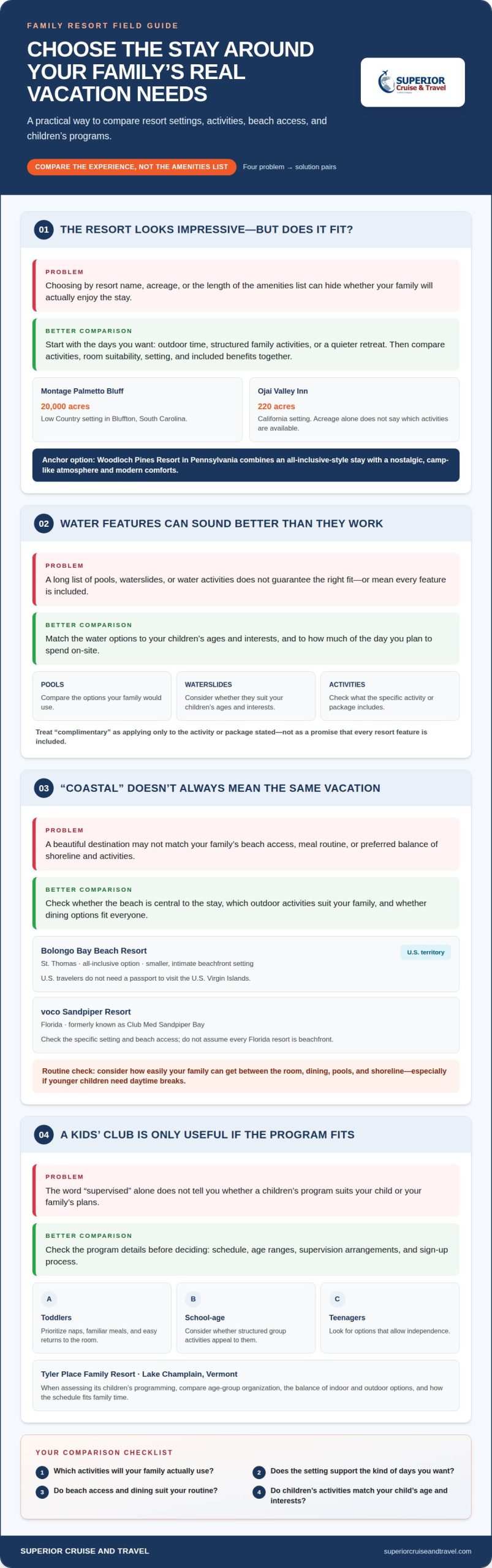
Start by matching the resort’s setting to the kind of days your family enjoys. Montage Palmetto Bluff in Bluffton, South Carolina, is set on 20,000 acres of Low Country, while Ojai Valley Inn in California occupies 220 acres. These settings offer a sense of space, but acreage alone doesn’t tell you which activities are available. Compare the experience you want, such as time outdoors, structured family activities, or a quieter retreat.
Water features can shape a family’s resort experience, too. Compare the pools, waterslides, and water activities with your children’s ages and interests. A resort with several pool options may suit a family planning to spend much of the day on-site, while other families may prefer a more balanced activity schedule. Treat terms such as “complimentary” as applying to the specific activity or package stated, not as a promise that every resort feature is included.
For a practical comparison, list the activities your family would use, such as golf, tennis, nature experiences, or group recreation. Then consider how each resort’s setting supports those interests. A large property may offer room to explore, while a compact resort may make it easier to get between facilities. Choose based on what your family will actually enjoy, rather than the length of an amenities list.
Plan once your travel dates and preferred room type are clear, especially if you’re traveling during school breaks or a particular season. Planning ahead gives you more opportunity to compare room options and package details. Rates and availability depend on travel dates, demand, room inventory, and package inclusions. To judge the overall experience, weigh activities, setting, room suitability, and included benefits together. That’s more useful than choosing by resort name alone.
2. Beach resorts and family-friendly coastal stays
For a beachfront island stay, Bolongo Bay Beach Resort on St. Thomas offers an all-inclusive option in a smaller, more intimate setting. St. Thomas is part of the U.S. Virgin Islands, a U.S. territory where U.S. travelers don’t need a passport. This can simplify travel planning while offering a distinctly tropical setting. Compare the beachfront location with your family’s priorities, including how much time you want by the water and how much variety you want beyond the shore.
Florida offers a different coastal option. voco Sandpiper Resort, formerly known as Club Med Sandpiper Bay, is a familiar name to look for while researching the property. Don’t assume every Florida resort offers the same beach access. Consider the specific setting and how it fits your plans. A beachfront stay prioritizes access to the shoreline, while a resort elsewhere in the state may suit families focused on on-site activities or inland excursions.
Compare destinations using three practical questions: Is the beach central to your stay? Which outdoor activities suit your family? What dining options work for everyone? A tropical island setting such as St. Thomas can make the coast the main attraction, while Florida offers another destination to consider. Look at the available dining options and meal arrangements, then decide whether they suit the children’s preferences and your daily routine.
Beach conditions and family routines matter as much as location. Think through how your family would get between the room, dining, pools, and shoreline. If younger children need breaks during the day, easy access to the room can make a beach-focused itinerary more practical. For older children who want variety, compare water activities and opportunities to spend time away from the sand. These questions help turn a scenic destination into a practical family choice.
Use a simple comparison before choosing: note each property’s setting, beach access, outdoor activities, and dining options. Then rank those factors by how your family likes to spend vacation days. Bolongo Bay Beach Resort’s intimate beachfront setting may appeal to families seeking a smaller-scale island experience, while voco Sandpiper Resort is another Florida option to consider. Don’t let “coastal” alone decide; the balance of shoreline, activities, and meals shapes the stay.
For help weighing coastal stays against other destinations, explore resort vacation options as part of your trip planning. A clear list of family priorities makes it easier to compare a tropical island getaway with a Florida resort, then choose the setting that best matches your plans.
3. Resorts with kids’ clubs and supervised children’s programs
For toddlers, prioritize a routine that allows for naps, familiar meals, and easy returns to the room. School-age children may enjoy structured group activities, while teenagers often prefer options that allow independence. These are age-based filters, not guarantees about any particular resort’s program. Before deciding whether a kids’ club suits your family, compare its schedule, age ranges, supervision arrangements, and sign-up process.
Tyler Place Family Resort sits along Lake Champlain in Vermont and is an option to consider for a family stay. Assess its children’s programming by looking at the details that shape the day: whether activities are organized by age, how indoor and outdoor options are balanced, and how the schedule fits family time. A lakeside setting may appeal to families planning outdoor activities, but the program should match each child’s interests.
“Supervised” can describe different experiences, so compare the practical arrangements rather than relying on the label. Look for clear age eligibility, drop-off and pickup procedures, activity descriptions, and ways staff communicate with parents. For a toddler, a short activity close to the room may be more useful than a long session. Older children may prefer a choice of projects, sports, or group outings.
Dining is another important part of the children’s experience. Check whether menus include familiar options, whether mealtimes fit around activities, and how easily the family can dine together. A children’s menu can simplify ordering, but also consider the choices available for adults and children with different tastes. For example, compare the meal schedule with the times your child usually eats.
Room layout, pool access, and childcare arrangements also affect how smoothly a resort stay works. Suites can give families more room for rest and downtime, while convenient pool access may suit children who enjoy swimming. These features vary by property, so compare them with your family’s needs instead of assuming every resort offers the same setup. For babysitting, focus on the arrangements, timing, and suitability for your child.
Before choosing, write down each child’s age, preferred activities, meal needs, and usual rest schedule. Use that list to compare program details and room options. A school-age child who enjoys group activities, for example, may value a different schedule from a toddler who needs quiet breaks. Tyler Place Family Resort’s Lake Champlain location is a starting point for considering a Vermont family stay; the best program is the one that fits your children and your plans.
4. What may not be included in resort rates
“All-inclusive” describes a package, not a universal list of benefits. At U.S. all-inclusive resorts, alcohol, premium excursions, or spa services may not be included in the rate. Compare the written inclusions before booking, separating included meals and activities from optional extras. This makes it easier to judge whether the package fits your family’s vacation plans.
How much do family-friendly luxury resorts in the USA cost per night? There is no single nightly rate: the amount depends on the destination, travel dates, room type, party size, and package inclusions. A quote tailored to your trip reflects these factors.
For an all-inclusive ranch vacation, examine which experiences the package actually covers. A guest ranch in Colorado may appeal to families seeking a land-based stay, but “all-inclusive” alone doesn’t mean every activity, meal, or service is covered. Compare the specific inclusions with your family’s plans, then account for optional outings separately.
The Farm at Brush Creek Ranch offers one example of a resort feature worth assessing: its culinary complex spans 20,000 square feet. That figure describes the complex, not what a rate includes. For any ranch stay, distinguish dining facilities from meal coverage, and activities on the property from excursions included in the package. This keeps an impressive amenity from being mistaken for an included benefit.
Use a short checklist when comparing ranch stays with other all-inclusive experiences. Note whether alcohol, premium excursions, and spa services are included, excluded, or optional, then compare meal arrangements and the activities your family expects to use. If your family plans a spa visit or guided excursion, include those items in its trip budget if the package excludes them. A package with fewer extras may still suit families who wouldn’t use them.
Read rate details alongside the itinerary, not in isolation. If a Colorado ranch package lists meals and outdoor activities, identify which activities are covered and which require separate payment. When comparing properties, put their inclusions side by side using the same categories. This shows where differences come from: a broader package, a different room choice, or extras that matter more to one family than another.
Before booking, make a final checklist: lodging, meals, alcohol, excursions, spa services, and planned activities. Mark each item as included, optional, or excluded, then decide which extras matter to your family. This makes “inclusive” clear for your vacation and helps you compare resort rates based on what your family will actually use.
5. Featured property in Coronado, California
The featured property in Coronado offers a coastal option to compare with the inland and island stays discussed earlier. Start by identifying your family’s main reason for choosing Coronado: shoreline time, a relaxed resort base, or access to nearby activities. Then assess whether the property’s setting supports that priority. This keeps the decision focused on the stay your family wants, rather than relying on the destination name alone.
Use the same practical checklist for Coronado that you would for any family resort. Consider room layout, your children’s ages, dining routines, and how you plan to spend each day. A family expecting frequent downtime may value a different room setup from one planning a full itinerary. Write down your priorities before comparing room options, so attractive details don’t distract from essential needs.
Next, map out a sample day around the featured property, including breakfast, outdoor activities, rest, and dinner. Ask whether the location and facilities fit that rhythm, especially if younger children need breaks between outings. Families with older children may instead prioritize varied activities and opportunities to explore. A simple itinerary makes mismatches easier to spot before booking.
Compare Coronado with a different trip style, such as an Orlando vacation centered on theme parks. The choices suit different plans: one may appeal to a family seeking a coastal setting, while the other may fit an itinerary built around attractions. Identify your nonnegotiables, then compare travel priorities, daily activities, and the downtime each trip allows. This helps your family choose the destination that fits its plans.
For the Coronado property, review room and rate details alongside your planned activities. Separate what you expect to use from extras that wouldn’t add value to your stay. If your family plans to spend substantial time away from the property, prioritize location and a room that supports comfortable downtime. If you expect to spend more time on-site, focus on the facilities and services that fit your routine.
Make the final comparison with each family member’s needs in mind. List the most important factors, such as sleeping arrangements, meals, outdoor plans, and convenient rest breaks. Then compare the featured Coronado property with your other options using the same criteria. A clear comparison helps you decide whether this coastal stay fits your vacation goals, without mistaking luxury styling for features your family will actually use.
Superior Cruise and Travel: Luxury Cruises
Superior Cruise and Travel can help you explore resort vacations as you compare family stays and weigh destination options. If your plans extend beyond a coastal resort, consider its luxury cruises as another way to shape a family getaway. The right choice depends on the experience you’re seeking, from a relaxed resort setting to exploring by ship. Use priorities from your resort comparison, such as family activities, dining, and preferred destination, to guide the conversation. For a broader voyage, you can also explore chartered cruise ships and world cruises. Contact Superior Cruise and Travel to discuss your vacation plans.
Shape a stay around your family’s priorities
Your next step is to turn inspiration into a plan that feels right for your family. Before choosing among family-friendly luxury resorts in the USA, agree on what matters most: a restful coastal setting, activities everyone can enjoy, or a schedule with room to change course. Then decide which trade-offs you’re comfortable making. A clear sense of your family’s travel style makes comparing destinations and resorts more straightforward.
Think beyond the property itself, too. Consider how you want each day to feel, what will keep the children engaged, and where you’d welcome help bringing the plans together. If you’re weighing a resort vacation against a different kind of getaway, Superior Cruise and Travel can help you explore options that fit your travel goals.
Take the next step at your pace. Contact Superior Cruise and Travel to discuss your plans and start shaping a family trip that feels personal, considered, and enjoyable.
Frequently Asked Questions
What is the best all-inclusive family resort in the USA?
Woodloch Pines Resort in Pennsylvania is a leading choice for families seeking an all-inclusive resort experience. Its camp-like atmosphere pairs nostalgic character with modern comforts, making it a notable option for families who want their stay to feel active and welcoming. To decide whether it suits your household, compare the experience you want with the property’s setting, activities, and package details.
Which luxury resorts offer the best kids’ clubs and supervised activities?
Tyler Place Family Resort in Vermont is a family-focused option along Lake Champlain. The best program for your family depends on your children’s ages, interests, and the kind of time parents hope to have. Consider how the resort’s schedule would fit your daily routine, including whether your children prefer group activities or more time together. A well-matched program can make planning each day easier for the whole family.
Which luxury resorts offer all-inclusive packages suitable for families?
Woodloch Pines Resort in Pennsylvania and Bolongo Bay Beach Resort on St. Thomas are two family-oriented options to compare. Bolongo Bay is a beachfront all-inclusive resort, while Woodloch is known for its camp-like setting and modern comforts. Package details matter as much as the all-inclusive label, so compare meal arrangements and included experiences with the activities your family expects to enjoy.
What are the best family luxury resorts in Florida, Hawaii, California, and the Caribbean-facing USA?
In Florida, consider voco Sandpiper Resort; in California, compare the featured Coronado property. Bolongo Bay Beach Resort on St. Thomas offers a beachfront option in the U.S. Virgin Islands. For Hawaii, choose based on your family’s preferred island setting and planned activities. The best fit depends on whether your priority is a beach-focused stay, a particular region, or a resort-centered itinerary.
What resort policies apply to children’s ages, childcare, and extra-person fees?
Resort policies determine which children can join specific programs, how childcare is arranged, and how room occupancy affects extra-person charges. Age categories can shape activity eligibility, while room type and the number of registered guests affect lodging terms. Before settling on a property, compare those policies with your children’s ages and sleeping arrangements. This helps you avoid choosing a room or program that doesn’t suit your family’s needs.
What additional fees and risks should families consider when booking a luxury resort?
Alcohol, premium excursions, and spa services may be excluded from U.S. all-inclusive resort rates. To avoid budget surprises, find out whether planned experiences fall outside the package and account for them separately. For example, a spa service or premium outing can change the overall vacation budget if the rate excludes it. Compare the inclusions with your itinerary before choosing.