
The booking window can shape the retreat as much as the destination. Companies should book most resort retreats 6-9 months in advance, while larger groups or peak travel periods may call for 9-12 months. That gives you more room to coordinate flights, contracts, and the experiences that make executive retreat destinations feel thoughtfully chosen rather than rushed.
It’s natural to want a memorable setting without making travel a burden for your team. For colleagues departing from major metropolitan hubs like New York, convenience depends on more than the resort itself: flight options, transfer time, and how easily everyone can reach the destination all matter.
This guide explains when to begin planning and how New York, the Dominican Republic, and other Caribbean destinations compare for access and retreat style. You’ll also find practical ways to match a location to your group’s goals, build a balanced agenda, and make the most of the time together, so you can plan with greater clarity and confidence.
Key Takeaways
- Compare New York, the Dominican Republic, and Caribbean options by how the full journey works for your team, not just by the setting.
- Weigh airport access and ground transfers alongside the retreat venue when assessing travel convenience.
- Choose a location that supports the purpose of the gathering, whether your priority is leadership development, strategic planning, or team connection.
- Shape the agenda around clear outcomes, focused work, and time for informal conversation.
- Explore resort vacations or cruise-based options to find a retreat format that fits your group’s goals.
New York City as a corporate retreat destination
New York City suits corporate teams that want dedicated meeting time alongside cultural experiences. Central Park covers 843 acres, giving groups room to plan outdoor breaks or informal walks. The Javits Center spans roughly 3.3 million square feet, making it a recognizable option for large-scale business events. For a retreat, match the venue to your agenda, not just the city’s name.
Build the schedule around a clear purpose. A strategy-focused group might reserve a quiet meeting room, then use a walk to shift into informal discussion. A company hosting a larger event could consider a major venue such as the Javits Center while holding working sessions in a more focused setting. Keep core sessions distinct from optional social activities.
For small teams, choose an intimate meeting setting that encourages candid discussion and easy participation. Boutique suite properties like Pointes North Inn demonstrate how condo-style accommodations can provide comfort and privacy for focused leadership gatherings. Larger groups need space for shared sessions and smaller breakouts, so a substantial event venue may better suit their format. In either case, match the destination to the group’s size, agenda, and desired balance of work and connection.
Mexico offers a different setting for a corporate retreat. Consider Mexico City when an urban environment suits the program, or Cancun when a resort-based experience is the priority. Before choosing, compare travel arrangements, meeting requirements, and the activities your team wants. A destination works well only when its practical details support the retreat’s goals.
Plan the duration around the work the team needs to accomplish. A corporate retreat at a resort is generally recommended to last at least 3 days. Start by setting 2-3 clear outcomes, such as strategy, recognition, training, or culture. Then alternate focused sessions with recovery time, breakout discussions, and evenings reserved for social connection.
For most resort retreats, begin booking 6-9 months in advance. Larger groups or peak travel periods may need 9-12 months. Early planning gives organizers more room to coordinate flights and contracts, and to arrange experiences such as private dinners or off-property excursions. Venue booking guidance also recommends 3-6 months ahead for the best selection and pricing.
Keep the agenda realistic. Allow time for transfers, meals, and audiovisual setup, and avoid filling every hour with presentations. The Internal Revenue Service says business travel expenses must be ordinary and necessary, not lavish, extravagant, or personal. Keep that standard in mind when planning the program and its activities.
This range helps planners compare hotel categories when considering lodging for a city retreat.
Balance focused work with restorative breaks. Keep lengthy meetings limited, build breakout conversations into the schedule, and protect evenings for colleagues to connect. Leave transition time around transfers, meals, and audiovisual setup.
Airport access and travel convenience
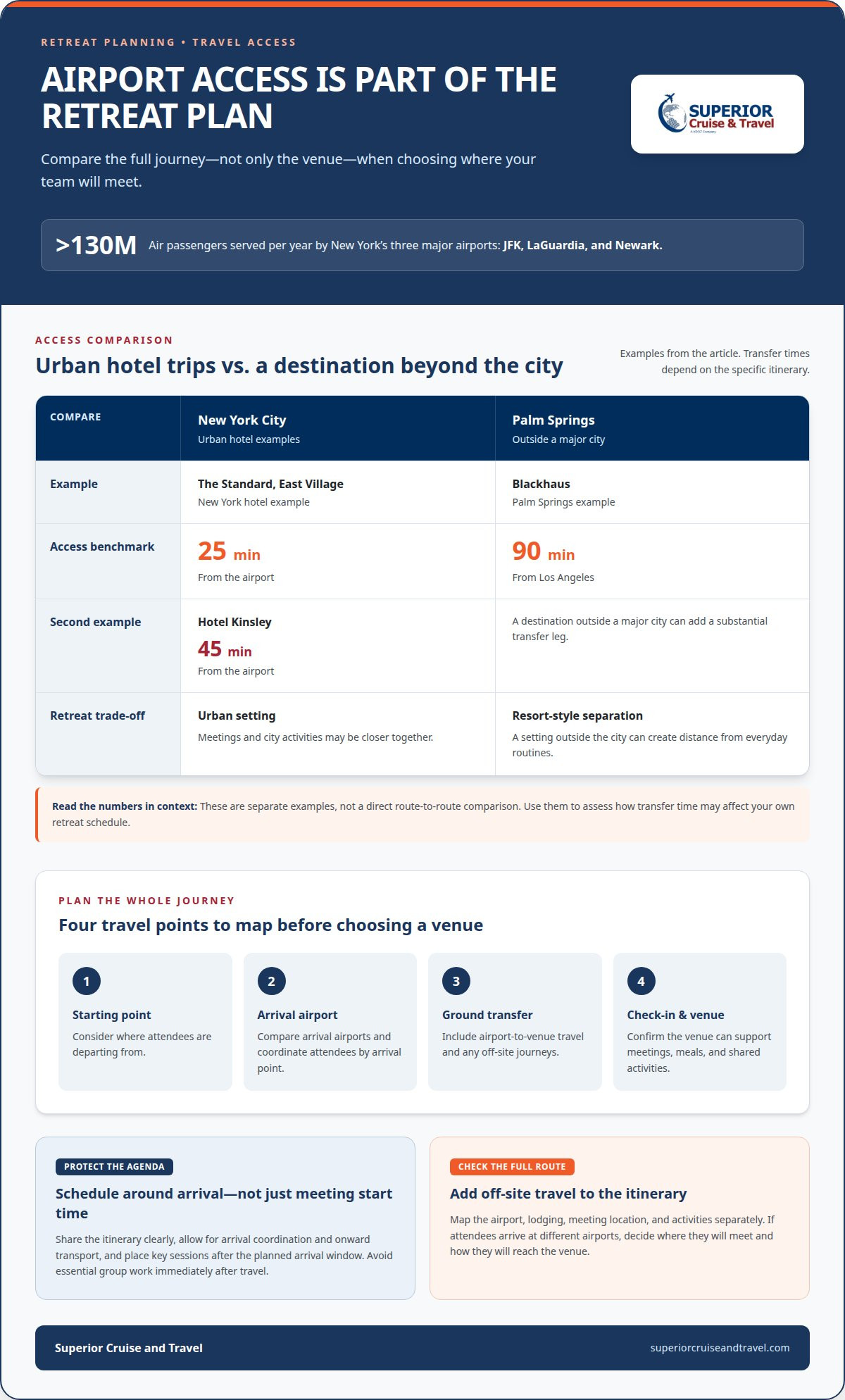
Choose a venue by weighing airport access, onward transfers, meeting needs, and the time available. For New York teams, compare arrival airports and lodging locations before settling on a setting. The metropolitan area’s three major airports, JFK, LaGuardia, and Newark, serve more than 130 million air passengers per year. That scale makes arrival planning an important part of the retreat, not a detail to leave until the agenda is finished.
What should companies consider when choosing an executive retreat venue? Compare the full journey for each attendee, from their starting point to airport arrival, ground transfer, and check-in. Then assess whether the venue can accommodate the group’s work sessions, meals, and shared activities.
In New York City, airport-to-hotel travel can vary by property. The Standard, East Village is 25 minutes from the airport, while Hotel Kinsley is 45 minutes from the airport. Use those examples to assess the importance of transfer time in your own itinerary. A shorter stated journey can leave more room for meetings, but the actual schedule should account for arrival coordination and the group’s onward transport.
Map the travel plan before selecting a venue. Mark the arrival airport, lodging, meeting location, and any off-site activity as separate points. If attendees land at different airports, decide where they’ll meet and how the group will reach the venue. If the program includes an off-site dinner or activity, factor in the extra journey when setting the schedule.
- Compare total journey time: Include airport-to-venue transfers, not just flight duration.
- Coordinate arrivals: Group attendees by arrival point before arranging shared transport.
- Protect agenda time: Place key sessions after the planned arrival window, not immediately after a flight.
Distance can change the character of a retreat. Blackhaus in Palm Springs is 90 minutes from Los Angeles, illustrating how a destination outside a major city may add a substantial transfer leg. A resort setting can offer separation from everyday routines, while an urban venue may keep meetings and city activities closer together. Compare those trade-offs against your team’s priorities.
For a New York-based group considering a Caribbean retreat, assess airport connections and the final transfer to the resort as one continuous journey. Share the itinerary clearly, schedule a buffer between arrival and the first session, and avoid placing essential group work immediately after travel. Teams planning travel can also review travel protection options as part of their trip arrangements.
Business retreats in the Dominican Republic
The Dominican Republic can give a corporate retreat a distinct change of scenery, but the right location depends on the program. Compare Punta Cana, Santo Domingo, and Puerto Plata against your team’s travel plans and meeting priorities. Assess each destination on its own merits rather than assuming every resort area suits the same event format.
Start with the work itself. If leaders need uninterrupted strategy discussions, prioritize a venue with a suitable meeting room, presentation setup, and quiet space for small-group conversations. If the retreat is also about recognition or relationship-building, consider how dining and shared activities can complement formal sessions. The setting should serve the agenda, not compete with it.
Treat amenities as practical requirements. List meeting space, meal arrangements, accessible common areas, and options for informal discussion, then mark each as essential or preferred. This helps your planning team compare luxury resorts consistently instead of choosing based only on photographs or general appeal.
Give travel logistics equal attention. Map the group’s arrival plans to the chosen area, then work out how attendees will get from arrival points to lodging and meeting spaces. If people arrive at different times, a staggered welcome plan may work better than one shared opening session. Keep the first scheduled activity flexible enough to accommodate the itinerary.
Use a site review to test the retreat experience from a participant’s perspective:
- Follow the daily route: Consider how attendees move between lodging, meetings, meals, and planned activities.
- Test the meeting format: Match the room layout to presentations, discussion, or breakout work.
- Review the shared experience: Choose social activities that fit the team’s purpose and comfort levels.
- Plan for transitions: Allow space in the schedule for meals, transfers, and room changes.
Local experiences can add meaning when they connect to the retreat’s goals. A leadership team might pair focused work with a shared cultural or culinary activity in the Dominican Republic. Make participation welcoming, and build the activity into the program rather than leaving too little time to rest or reflect.
Define your decision criteria before comparing proposals. Record the agenda needs, travel arrangements, preferred amenities, and desired balance of work and social time. Apply the same criteria to every location, including Punta Cana, Santo Domingo, and Puerto Plata. A consistent comparison helps you choose a resort setting that supports the team’s purpose and creates a cohesive experience.
Caribbean retreat locations
Compare Caribbean destinations by how well each supports your meeting format, travel plan, and team priorities. Jamaica, Aruba, Barbados, the Bahamas, and Puerto Rico can all make an initial shortlist. Evaluate them as distinct options rather than assuming one island suits every corporate group.
Start with a destination scorecard. Record attendees’ departure points, preferred dates, meeting requirements, and desired balance of work and shared activities. Assess each location against the same criteria. This keeps a scenic image from outweighing practical needs, such as coordinating arrivals or finding suitable spaces for focused conversations.
For example, compare proposed retreats in Jamaica and Aruba by mapping each attendee’s journey. Include flight connections, arrival times, and ground transport to the venue. The route that looks simplest on a map may not fit the group’s actual itinerary, so compare complete journeys rather than destination names alone.
Next, define the setting your agenda requires. A leadership team planning confidential discussions may value private meeting rooms and quiet breakout areas. A group focused on connection may prefer shared spaces that make informal conversation easy. Apply the same criteria to Barbados, the Bahamas, and Puerto Rico before choosing a property.
Assess more than the meeting room. Check whether the venue layout can support presentations, smaller discussions, meals, and social time without a complicated schedule. A program with several breakouts, for instance, needs a different room arrangement from a retreat centered on one full-group discussion. Write down these requirements before comparing proposals.
- Travel: Map attendee origins, connections, arrivals, and transfers for each shortlisted location.
- Work: Match room layouts and meeting spaces to the retreat’s actual agenda.
- Experience: Select activities that complement the purpose of the gathering.
- Schedule: Allow time for meals, transitions, and changes between meeting spaces.
Use your shortlist to build a realistic itinerary for each destination. For a Barbados option, place the main working session after planned arrivals, then allow time for meals and informal conversation. Repeat the exercise for the Bahamas or Puerto Rico. Comparing sample schedules can show whether each setting supports your team’s priorities.
Bring decision-makers together around the scorecard. Ask them to rank travel convenience, meeting suitability, and the desired retreat experience. If Jamaica best matches the group’s work needs while Aruba better fits its preferred style, discuss that trade-off directly. A shared comparison makes the final choice clearer and easier to explain.
Which executive retreat venues are best for leadership training and strategy planning?
The best venue supports the leadership work, not just the occasion. For strategy planning, prioritize a private meeting room, a layout that encourages discussion, and space to review shared materials. For leadership training, choose a venue where participants can move easily between full-group instruction, practice exercises, and smaller conversations.
Begin with the agenda. List each session, its format, and the materials participants will use. A presentation needs clear sightlines and suitable audiovisual equipment; a collaborative planning exercise may need movable seating and wall space for notes. Compare city hotels, resort meeting spaces, and other venues against the work your team will actually do.
Room layout matters. A boardroom arrangement can support focused discussions among senior leaders, while smaller tables may work better for group exercises. If the program uses both formats, map each session to a room setup. This can reveal whether one venue supports the full program or requires disruptive room changes.
- For strategic decisions: Prioritize privacy, comfortable discussion seating, and room for documents or presentation materials.
- For leadership practice: Look for a layout that can support demonstrations, paired exercises, and group feedback.
- For mixed agendas: Compare the time and effort needed to move between meeting formats.
- For confidential topics: Include a private space in the venue plan, not only the main meeting room.
Treat the surrounding environment as part of the learning design. A resort can separate participants from familiar office routines, while an urban hotel may suit a shorter program or a team that prefers a city setting. A leadership group working through a complex decision may value fewer distractions; a team combining training with city activities may prefer a central location.
Check how the venue handles transitions. Trace the route from guest rooms to the meeting space, then account for meals, breaks, and scheduled activities. A long walk between rooms or a change of building can interrupt concentration. A clear daily plan helps organizers spot these friction points before they disrupt the sessions.
Before selecting a venue, compare its proposed room plan with the session schedule. Note the setup required, the materials needed, and the spaces participants will use. Then select the option that best supports the retreat’s purpose and the team’s working style. If you’re organizing a leadership gathering, plan your corporate retreat event around the sessions that matter most.
Moniker planned a retreat in Phuket, Thailand, for 180 Airalo team members, illustrating how a destination venue can bring a distributed team together for shared planning.
Superior Cruise and Travel: Luxury Cruises
Superior Cruise and Travel can help teams plan a retreat around a resort vacation or cruise. If your group wants a setting beyond a conventional hotel, consider whether a luxury cruise or chartered cruise ship fits your plans. For a longer itinerary, a world cruise is another format to explore. The right option depends on your group’s goals, preferred setting, and desired balance of time together and independent activities.
Bring your priorities to the planning conversation: the experience you want, the destinations you’re considering, and what your team hopes to gain from traveling together. This gives you a clear starting point for comparing travel formats and shaping a retreat that suits your organization.
Contact Superior Cruise and Travel to discuss cruise and resort options for your team.
Shape the next step for your team
A retreat can be more than a change of scenery. Use it to build shared momentum that continues after everyone returns: define the decisions the group needs to make, who will carry them forward, and how the team will stay accountable. That intention can guide your choice of executive retreat destinations and help make the experience purposeful from the first planning conversation.
If you’re considering an alternative to a traditional resort stay, Superior Cruise & Travel offers Luxury Cruises, Chartered Cruise Ships, and World Cruises. These options provide a different setting for bringing colleagues together, depending on the experience your organization wants to create.
Contact Superior Cruise and Travel to discuss travel options for your team. A thoughtful plan can turn time away into a positive step toward stronger collaboration and clearer direction.
Frequently Asked Questions
Want to learn more about retreat planning?
Write down the decision or outcome your team needs from the retreat. Then identify who should attend, which sessions will support that goal, and what travel format suits the group. A leadership team resolving a strategic question may need protected discussion time, while a company gathering focused on connection may prioritize shared experiences. These choices give venue and agenda planning a practical foundation.
What are the best executive retreat destinations near major U.S. airports?
New York City can suit teams whose attendees have access to JFK, LaGuardia, or Newark airports, which serve the metropolitan area. The best fit depends on where people are traveling from and how easily they can reach the venue after landing. Compare each complete itinerary, including arrival coordination and ground transportation, rather than choosing based only on airport proximity.
When is the best season to book an executive retreat in popular U.S. destinations?
Choose dates around your team’s work calendar, destination priorities, and preferred retreat experience. For a city gathering in New York, consider whether the program depends on outdoor activities or indoor meetings. For a resort retreat, align the travel window with your group’s schedule and the experiences you want to include. Setting priorities early helps narrow down both the season and destination.
How far in advance should an executive retreat be booked?
Book most resort retreats 6-9 months in advance. For larger groups or peak travel periods, plan on 9-12 months. That lead time can make it easier to coordinate flights and contracts and plan group experiences. Venue selection can also begin 3-6 months ahead when seeking the best selection and pricing. Set the dates first, then move into venue and travel planning.
How do mountain, coastal, and urban executive retreat destinations compare?
In New York, meetings and city activities may be closer together, while a resort setting can offer separation from everyday routines. For mountain locations, arranging dedicated ground transit such as Comfort Car Service ensures smooth executive transfers from regional airports into alpine lodges. For a Caribbean retreat, consider airport connections and the final transfer to the resort as one continuous journey.